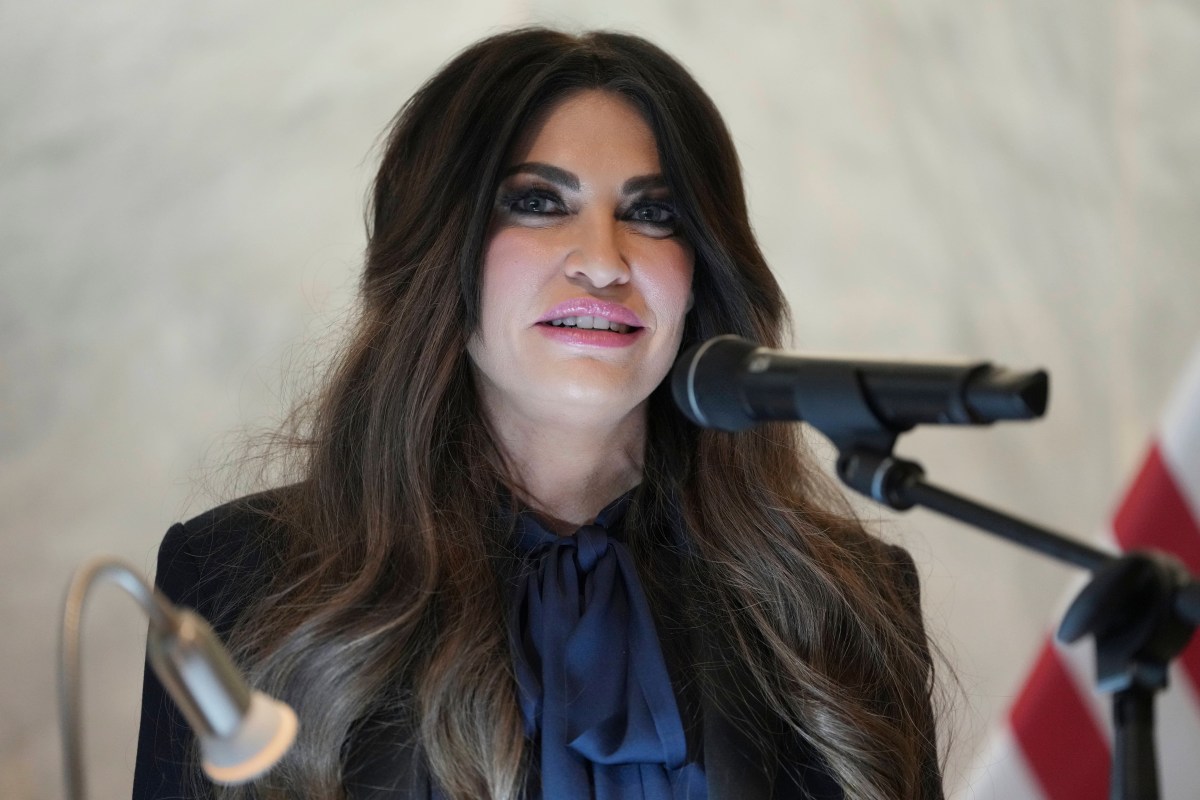
Guilfoyle's $100K Scandal: List of Trump Allies Accused of Selling Access
Only social or community posts, or a single source.
What happened
Kimberly Guilfoyle, the U.S. ambassador to Greece and former fiancée of Donald Trump Jr., is facing allegations that she asked a wealthy Trump supporter to pay $100,000 toward her American Express bill in exchange for help reaching senior administration officials. (GDELT Global Knowledge Graph, 10:15)
Read the reporting
1 reportGuilfoyle's $100K Scandal: List of Trump Allies Accused of Selling Access
Kimberly Guilfoyle, the U.S. ambassador to Greece and former fiancée of Donald Trump Jr., is facing allegations that she asked a wealthy Trump supporter to pay $100,000 toward her American Express bill in exchange for help reaching senior administration officials.
Text messages first reported by The Wall Street Journal show Guilfoyle allegedly pressing longtime Trump donor Eric Deters for the money in July 2025, just days before her Senate confirmation hearing. The messages, which Deters provided to news organizations, have raised questions about whether a personal financial request crossed the line into an attempt to sell political access.
The allegations have also revived scrutiny of other figures in Trump's political orbit, including individuals convicted of using their connections to pursue government appointments, lobby for foreign interests or obtain influence with the administration.
Guilfoyle's attorney, Jesse Binnall, disputed the authenticity of the messages and said that her client was owed money for travel and speaking engagements before her nomination. Deters disputed owing her any balance.
Newsweek has reached out to Guilfoyle's attorney, Deters, the State Department and the White House for further comment via email.
Kimberly Guilfoyle's $100,000 Request: 'Honey Please'
According to the Journal, Guilfoyle contacted Deters on July 3, 2025, asking him to pay her American Express bill directly. Her Senate confirmation hearing to become ambassador to Greece was scheduled for July 9.
The Journal reported that Guilfoyle wrote in a Signal message: “It won't show up anywhere if you wire money to American Express.”
In another message, she allegedly pressed Deters to act quickly: “I have been officially announced honey please I need you to get this done for me today.”
Deters said he understood the proposed financial assistance to be connected to Guilfoyle's willingness to use her political connections on his behalf.
Deters, a former Republican congressional candidate and conservative media personality, had allegedly sought Guilfoyle's assistance with tax and legal issues, including efforts to draw federal attention to a dispute involving an Ohio surgeon who fled to Pakistan.
He said he had previously paid her for speaking engagements and had discussed compensation for other work.
Deters characterized the $100,000 request as an explicit exchange of money for influence.
“I have no doubt it was pay to play," Deters told CBS, describing his interpretation of the messages. "It was a quid pro quo.”
Deters did not make the $100,000 payment. He said he told Guilfoyle his wife wouldn't approve. He later told CBS that was an "excuse."
Binnall has disputed the authenticity of the messages.
The U.S. Embassy in Greece said in a statement to the Journal that Guilfoyle's career in and out of public service was guided by “deep and abiding values” and that she remained committed to representing the American people with dedication and integrity.
Trump administration members have also commented on the allegations.
Vice President JD Vance was asked about allegations on Thursday. While the reporter did not name Guilfoyle directly, they asked what he thought of a U.S. ambassador asking someone to pay off debt in exchange for access to other government officials. “Of course, I don't like anybody selling access to another government official. Certainly, a high-level government official," Vance responded.
Secretary of State Marco Rubio was asked about the allegations while traveling in Greece. “I don't even know if it's true or not true,” Rubio said, before criticizing the assumption that published reports should automatically be accepted as fact.
Trump Allies Accused Of Selling Influence and Access
Guilfoyle's case is not the first time a person in Trump's political orbit has faced scrutiny over money, government appointments or the use of political connections. Several cases from the first Trump administration involved criminal conduct related to influence, foreign lobbying or efforts to obtain government positions.
### Stephen Calk: $16 Million in Loans for a Government Job
Stephen Calk, the former chief executive of The Federal Savings Bank, was convicted in 2021 of financial-institution bribery and conspiracy.
According to the Justice Department, Calk arranged about $16 million in loans for Paul Manafort, Trump's former campaign chairman, in exchange for Manafort's help in securing a senior position in the incoming administration.
Calk reportedly supplied a ranked list of positions he wanted, including Treasury secretary, deputy Treasury secretary and secretary of the Army. Prosecutors said he used the bank's lending power to secure personal benefits through Manafort's political connections.
A federal jury found Calk guilty in July 2021. He was sentenced to one year and one day in prison in 2022.
### Elliott Broidy: Millions for Lobbying the Trump Administration
Elliott Broidy, a major Republican fundraiser and vice chairman of Trump's inaugural committee, pleaded guilty in October 2020 to conspiring to violate the Foreign Agents Registration Act.
According to his plea, Broidy agreed to lobby Trump, the attorney general and other senior officials to drop civil forfeiture proceedings and related matters connected to the Malaysian state investment fund 1MDB.
Broidy was paid at least $9 million by Malaysian businessman Jho Low for his efforts, according to the Justice Department. Broidy also agreed to lobby the administration on behalf of Chinese interests concerning a dissident living in the United States.
The lobbying campaigns were ultimately unsuccessful, but the payments and undisclosed foreign representation formed the basis of the criminal case.
Trump granted Broidy a full presidential pardon on January 19, 2021, before sentencing.
### George Nader: Foreign Contributions Intended to Obtain Political Access
George Nader, an adviser to senior United Arab Emirates officials, helped funnel millions of dollars in foreign money into U.S. political committees during the 2016 presidential election.
The Justice Department said Nader and a business associate arranged transfers intended to facilitate unlawful campaign contributions to gain access to and influence with a presidential candidate and others. The scheme involved at least $3.5 million in unlawful contributions.
After the election, the associate also made a $1 million contribution to Trump's inaugural committee and obtained inauguration tickets, bringing Nader into the wider story of foreign money and access surrounding the incoming administration.
Nader was sentenced to an additional year and eight months in prison in 2023 for his role in the foreign-contribution scheme. He was also serving a separate prison sentence for unrelated child-sex offenses.
### Imaad Zuberi: Political Donations and Foreign Lobbying
Imaad Zuberi, a venture capitalist and political fundraiser who donated to candidates from both major parties, was sentenced to 12 years in federal prison in 2021.
Zuberi pleaded guilty to offenses involving undisclosed foreign-agent activity, tax evasion, illegal campaign contributions and obstruction of justice. Prosecutors said he used foreign money to finance political contributions and then used the influence those contributions helped obtain to lobby U.S. officials on behalf of foreign principals.
The Justice Department described his activities as turning unregistered foreign lobbying into a business enterprise.
### Michael Cohen: Accused of Offering Access to the Incoming Administration for $1 Million
Unlike the other cases, Michael Cohen, Trump's former personal attorney, was not convicted of his money-for-access allegations.
Cohen was accused of soliciting at least $1 million from Qatar's government in late 2016 in exchange for access to and advice about the incoming Trump administration. The alleged offer was made during the transition period, and Qatar declined it, the Washington Post reported in 2018.
Cohen allegedly discussed the proposed arrangement with a Qatari investor after a Trump Tower meeting involving Qatar's foreign minister and Michael Flynn, who later became Trump's first national security adviser.
The reported solicitation was part of a broader consulting operation in which Cohen promoted his relationship with Trump to potential corporate clients. Companies allegedly paid him for consulting services, including advice about the administration and government policy.
Cohen pleaded guilty in 2018 to multiple federal offenses, including campaign-finance violations, tax evasion and making false statements to a financial institution. However, those convictions did not establish that the reported Qatar solicitation itself was a criminal offense.
Second Term Controversies
There have been no convictions of Trump allies during his second term as of October 9, 2026, but several allegations have arisen against Trump allies or members of the administration.
### Tom Homan: $50,000 in a Closed Bribery Investigation
Tom Homan, Trump's border czar and a former acting director of Immigration and Customs Enforcement, became the subject of a controversy in 2025 after Reuters reported details of a bribery investigation that had been closed by the Justice Department.
According to Reuters, Homan accepted $50,000 in cash from an undercover FBI agent in 2024 during an investigation into alleged promises to help secure future immigration-related government contracts after he returned to the Trump administration.
Sources told Reuters that the transaction was recorded and that Homan had discussed keeping the money in a trust until he had completed his government service. The allegations concerned prospective contracting assistance rather than merely arranging meetings with officials.
The investigation was closed in 2025. FBI Director Kash Patel and Deputy Attorney General Todd Blanche said investigators had found “no credible evidence of any criminal wrongdoing” and described the probe as politically motivated.
Homan was not charged in the matter.
### Donald Trump Jr.'s Wedding and Money From a Putin-Linked Russian Oligarch
Questions about money and access in Trump's political orbit have also extended to his family. A recent report by ProPublica found that Russian oligarch Umar Kremlev, a close associate of Russian President Vladimir Putin, financed substantial portions of Donald Trump Jr.'s lavish wedding celebration in the Bahamas.
According to ProPublica, Kremlev paid hundreds of thousands of dollars in expenses associated with the three-day celebration, including the rental of a private island and a fireworks display. The event took place in May, following Trump Jr.'s wedding ceremony.
Trump Jr. and his wife, Bettina, subsequently confirmed that Kremlev had hosted the post-wedding celebrations as a gift. Bettina described Kremlev as a “dear friend” in a social-media post.
Kremlev told the Associated Press earlier this month that Trump Jr. had reimbursed him for the expenses. President Trump also said the debt had been repaid and defended the arrangement as a form of generosity between friends.
Democrats have been highly critical of the gift, with Senate Democratic Leader Chuck Schumer suggesting it was a "bribe."
“You're dealing with a Russian oligarch, not just a cousin who's giving you a gift," he said. “Sometimes a wedding gift is a bribe from a foreign autocrat.”
However, the wedding expenses, as reported, do not by themselves establish that Kremlev purchased political access, that Trump Jr. promised government favors or that a crime occurred. The couple characterized the spending as a personal gift, and the reported reimbursement is a material part of the account.
Newsweek has reached out to the Trump Organization for comment.
Newsweek’s reporters and editors used Martyn, our AI assistant, to produce this story. Learn more about Martyn here. Contact Newsweek editors on this story: Samantha Beech and Gray R. Thomas
Why it is over
- No engagement data available from these sources; score uses mention signals only
Attention graph
Not enough history in this window yet. The engine measures every five minutes.
Timeline
- DetectedFirst detected (GDELT Global Knowledge Graph) source
- StateOver
single source and no mention for 24h
Where it started
How it spread
- Step 1News outletsGDELT Global Knowledge Graph10:15
Internet reaction
No social or community posts about this yet from the platforms we ingest.
What we know
- Nothing independently established yet.
What we don’t know
- Independent confirmation is missing; treat specifics as unverified
- Only one source so far
All sources (1)
Attention is measured from these mentions only. Platforms shown: News. We never invent signals for platforms we do not ingest.
Follow for your feed
Follow the topic or the people and places in this story and they shape your For you page. Kept in this browser only.