
The arc of the physical universe bends towards heat, but maybe we can bend it back
Only social or community posts, or a single source.
What happened
I have been open about feeling a little exhausted and despairing of late (if by open, one means publishing an essay about it on the Sunday oped page of the Times). Part of it is the ever-growing sense that AI is out-of-control (listen to Ezra Klein’s interview with David Robinson yesterday) and part of it is the psychic toll of the daily dispatches from our nation’s leader (today: anyone who doesn’t use the “highly accepted new and more accurate term Super Intelligence is THE ENEMY.”) And much of it is the news from the physical world. (GDELT Global Knowledge Graph, 13:00)
Read the reporting
1 reportThe arc of the physical universe bends towards heat, but maybe we can bend it back
I have been open about feeling a little exhausted and despairing of late (if by open, one means publishing an essay about it on the Sunday oped page of the Times). Part of it is the ever-growing sense that AI is out-of-control (listen to Ezra Klein’s interview with David Robinson yesterday) and part of it is the psychic toll of the daily dispatches from our nation’s leader (today: anyone who doesn’t use the “highly accepted new and more accurate term Super Intelligence is THE ENEMY.”) And much of it is the news from the physical world.
I’m going to start with that hard scientific update today, but I promise I’m not going to end there—the arc of this short essay is going to tend towards the more hopeful. Because there are ways to fight, and this is the moment to be doing it, and because if you’re like me you need some of that spirit right now.
Anyway, to begin with the tough stuff: New data today makes ever clearer this is going to be an historic El Niño—as Evan Bush reports
Sea surface temperatures have spiked to record levels in the tropical Pacific this fall, a sign that the pattern continues to strengthen. In the region where the El Niño trend is typically measured, temperatures are 6.1 degrees Fahrenheit higher than normal.
In its latest update, the National Oceanographic and Atmospheric Agency said the pattern was strengthening and that there was a 90% chance of a “very strong event” this fall and winter, with a 75% chance of becoming a historic event larger than any El Niño since 1950.
Sascha Pare provided more details:
The sea surface temperature in a key section of the central equatorial Pacific Ocean has now surpassed all previous temperatures on record for this region, exceeding 86 degrees Fahrenheit (30 degrees Celsius) for the first time, according to preliminary data released Monday (Oct. 5).
Specifically, these temperatures occurred in the Niño 3.4 region, located between 5 degrees north and 5 degrees south latitude, and 120 degrees west and 170 degrees west longitude.
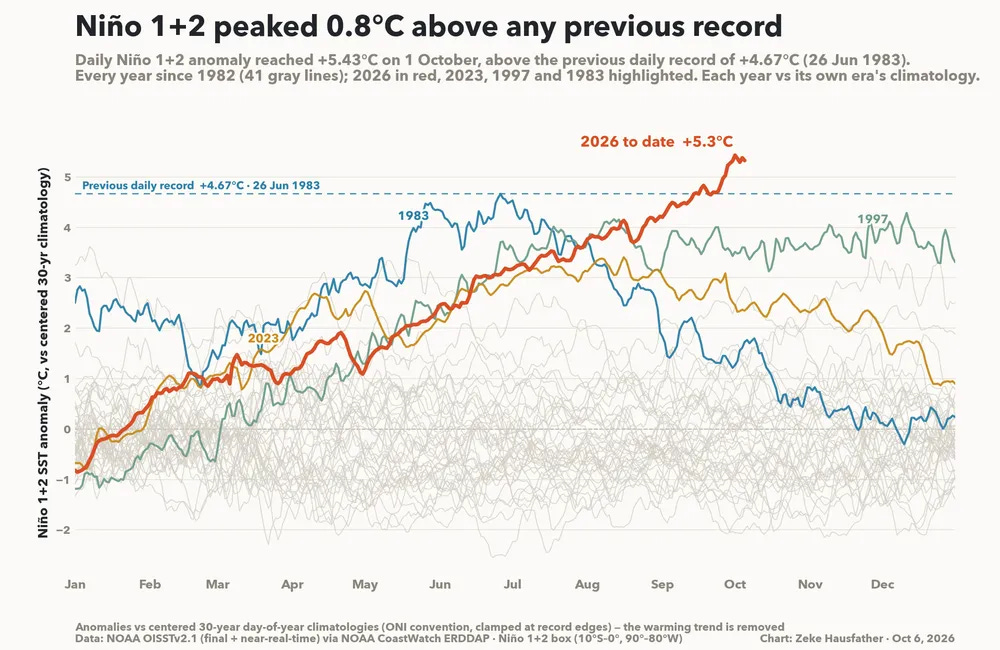
If you want a look, here’s a temperature graph from elsewhere in the Pacific. The red line is this year. It’s unlike anything we’ve ever seen before.
UNICEF said Tuesday that they expect 347 million children in nearly 100 countries will be exposed to flooding or drought.
“For children, El Niño is far more than a weather pattern. It can mean increased displacement, malnutrition, water shortages, and disease outbreaks. Children are also at risk of schools closing, while families could experience added financial hardship,” Catherine Russell, who heads the agency, said.
The Climate Impact Lab at the University of Chicago is now predicting that heat alone—never mind the floods and storms—could kill 451,000 people over the course of a year
“The estimate of 451,000 people is such a large number that it can be numbing, but it is made up of parents and children, grandparents and neighbours, people going to work, caring for families, and living their lives,” said Michael Greenstone, co-founder of the Climate Impact Lab and a professor at the University of Chicago, who co-authored the report.
Meanwhile, the World Food Programme has estimated that about 50 million people will be pushed into acute hunger as El Niño cuts harvests around the world. These kinds of effects are already being felt: the worst air in the world today is in Singapore and Malaysia because much of a drought-stricken Indonesia is on fire
Swaths of Southeast Asia have been clouded in choking smog in recent weeks as Indonesia battles one of its worst wildfire seasons in years. The uncontrolled blazes stem from the long-running use of slash-and-burn agricultural practices, but fire conditions have been exacerbated by an intensifying El Niño that’s parching the landscape.
The number of hotspots last month was the highest since 2015, when a regional haze emergency caused widespread disruptions and diplomatic tensions, according to the Forestry Ministry’s fire-monitoring platform SiPongi.
And of course it’s not just humans that are affected. Active fires cover half the habitat of critically endangered orangutans across the region. Prya Bisambahr reports that
Rescuers in Indonesia are finding orangutans with burns, severe thirst and breathing problems as fires destroy their forest homes. Some mothers have escaped with babies still clinging to them.
This kind of damage is endemic of course—a new study this week found that the world’s largest penguin colony has declined by two-thirds since 2011 because “human-driven heating has pushed up winter temperatures on and around the Antarctic peninsula to 5C above preindustrial levels, one of the fastest rises in the world.” I’ve been to this colony, before its collapse; it guts me to think of its demise, just as it guts me to see pictures this week from Guatemala where record rains from El Niño have led to land collapse destroying homes
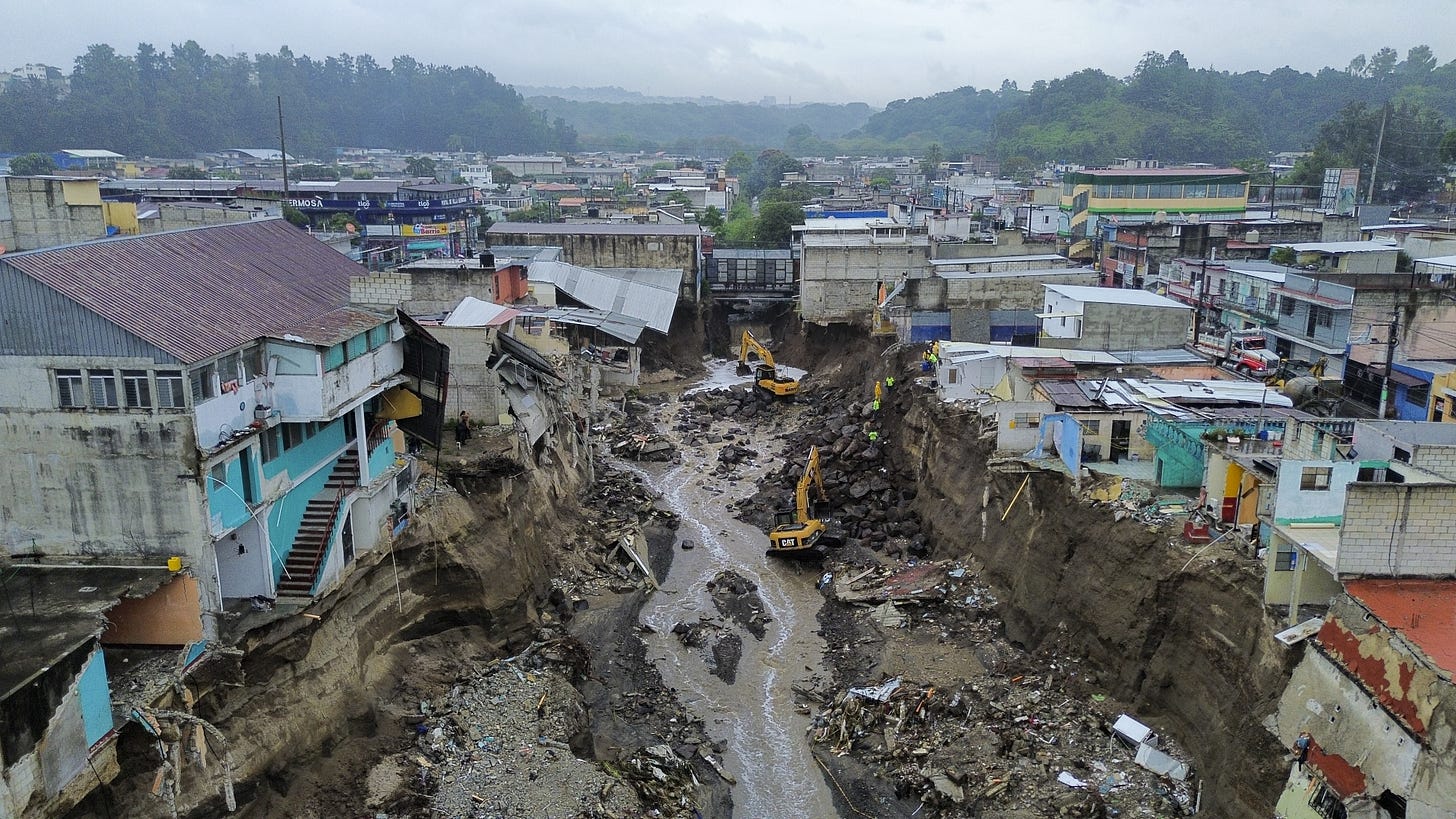
El Niño, likely exacerbated by climate change and definitely riding in on top of already overheated seas, will raise temperatures to places that no member of our species has yet experienced. It will be a preview of normal weather circa 2035 or 2040. It will be grim.
And it also may—and here the arc starts to bend a little bit, so chin up—give us a chance to see if humans can rise to the occasion. We’ve had climate-driven disasters aplenty, of course, probably beginning around Katrina. But these will be different because they are the first to come in a period when an alternative to fossil fuel is now easy to imagine and cheap to provide. Now, if humanity decides to move fast, it can. And recognition of the danger plays a role in that.
We got a bit of a controlled experiment in western Europe this summer, where temperatures reached their highest levels ever. As Ajit Naranjan reports:
The report found at least 60% of western Europe suffered through temperatures above 30C on 17 days this summer. In 2003, a year also marked by ferocious heat, this was observed on 11 days, and in 2025 on just seven. The high heat led to a record-breaking 13 days of “very strong” heat stress across western Europe…
“The consequences extended far beyond temperature records – affecting water availability, energy systems, transport, ecosystems and human health,” said Samantha Burgess, a climate scientist at the European Centre for Medium-Range Weather Forecasts. “As the climate continues to warm, events like these underscore the importance of building resilience to increasingly interconnected climate risks.”
Compounding extremes of heat, drought and fire proved particularly damaging. European sea surface temperatures this summer also broke records, the report found, while the continent’s rivers experienced their lowest summer flows in more than 30 years. Hot weather and widespread drought helped wildfires run rampant.
And in turn, that seems to have moved attitudes. Lorraine Whitmarsh and Bella Zanin just published new survey data from the UK:
High temperatures made more 50% of British people more fearful about the future, including how hot summers will affect children. One poll found that 65% of the British public were now concerned about climate change, and only 16% unworried. Among Reform supporters this was 46% and among Green Party supporters 87%.
Polling shows that climate change and the environment shot up people’s lists of concerns in 2026, with 51% of people saying the recent heatwaves made them feel it’s more important that the UK government and businesses tackle climate change.
As it happens, when you accurately inform people about the crisis we face, their desire to act goes up dramatically. Pippa Neill reports on the success of a “National Emergency Briefing” in the UK—a movie that debuted ten months ago and has now been seen by about 185,000 Britons
The team behind the event crowdfunded to produce the People’s Emergency Briefing, a film outlining the urgent threats that climate and nature breakdown pose to food security, the economy and public health.
The film, which has so far been viewed by an estimated 185,000 people at more than 3,400 screenings, calls on the government to stage a primetime, televised emergency briefing on the climate and nature crisis.
Of the 13,000 people surveyed, 87% said watching the film made them more motivated to act. Watching the film is associated with a “substantial shift” in environmental understanding and concern.
Furthermore, 89% of people said the government should respond to the crisis with emergency-level mobilisation, similar to the Covid-19 pandemic or the second world war.
The logic of the climate crisis El Niño version joins with the logic of the endless-war-for-oil Iran version. At the always-worth-watching OilPrice.Com website, Haley Zaremba provided a fascinating update yesterday of the impact of Trump, Hegseth, and Rubio’s High-T strategic failure in the most important places on earth for the climate future.
When the United States and Israel began their military offensive against Iran in February of this year, Iran responded by closing down the Strait of Hormuz – through which one-fifth of the world’s oil and gas trade flowed on any given day – essentially overnight. The sudden disappearance of 18 million barrels per day from the global marketplace caused enormous energy shocks around the world, and especially in cash-poor, import-dependent developing economies.
The result has been that some of the world’s emerging economies have turned their energy security stratgies around on a dime, turbocharging their clean energy transitions to provide reliable and indigenous energy sources and buffer themselves from future global oil and gas shocks. Since March, approximately 25 countries have introduced structural policies to boost electrification, according to Australia’s ABC News. As a result, many of the world’s developing economies – and even some of the poorest – are now outpacing the richest nation in the world when it comes to clean energy development and electrification.
As David Fickling points out, that’s bad news for LNG exports to Asia, precisely the region that Big Oil has been insisting will sustain its growth far into the future:
Stung by high costs and supply uncertainty, Asian governments are busy throwing those forecasts on the bonfire.
Thailand is the most prominent example. On paper, the country is a paragon of the gas market. Its economic boom in the 1980s and 1990s can largely be attributed to the opening up of domestic fields. Methane still provides almost two-thirds of electricity, a larger share than you’ll see in gas-fueled giants like the US and Russia. In Shell’s latest outlook, it’s the most exciting prospect in emerging Asia, with LNG imports five times higher in 2040 than they are now.
Bangkok has other ideas. Under the government’s latest power market plan, released in draft form earlier this month, renewable energy will increase to 50% from 20% of the grid within the next decade, before rising as high as 89% around 2050. A core reason for the shift? In the words of Energy Minister Akanat Promphan, to reduce reliance on “expensive and volatile spot LNG imports.”
It’s far from alone. Look at Bangladesh, Shell’s second-ranked future growth market in the region. Its dependence on LNG has been pushing the economy to the brink in recent weeks, as we’ve written. The main plan for solving that crisis is to increase solar power generation and open up offshore gas exploration blocs to eke out the last dregs from its domestic fields, according to Prime Minister Tarique Rahman. “We will no longer be consumers of imported energy. We will be solar power producers,” he told parliament earlier this month.
Other purported boomtowns aren’t looking much better. The Philippines has been shifting toward using gas to backstop renewables rather than as the core of its power system, as once envisaged. In Vietnam, a huge, promised LNG fleet is looking increasingly stranded, with the government resisting developer demands for extraordinary purchase promises guaranteeing as much as 95% of their sales for up to 25 years.
The basic bottom line, Fickling says, is simple:
For most of the past decade, the most powerful argument against the march of zero-carbon electricity in favor of using gas as a compromise “bridge fuel” has centered on the energy trilemma — the idea that power sources must be both clean, cheap, and secure. For consumers of energy, it’s not enough that a wind farm has low emissions: It also needs to be more affordable and available whenever it’s needed.
Nowadays, LNG is failing on all three. It’s never been clean, but these days it’s not cheap, either: Just buying the gas for an existing plant can cost more than building a brand-new solar-plus-storage system from scratch. As for security, that argument fell apart the moment Iranian drones closed off roughly a fifth of the global market, plunging Asian importers into blackouts and power rationing.
If you’d prefer a few anecdotes to go with your data, here’s a cheerful one, from Fickling’s Bloomberg colleague Javier Blas, a hard-nosed commodities guy, just wrote a column about why he’d finally bought an EV, and about the larger context. As he points out,
The twin oil crises of 1973 and 1979 dramatically reduced the rate of global oil demand growth. Will the current shock do the same? It’s early days, but the parallels are striking. As happened 50 years ago, today’s crisis hit just when technological, policy and social trends were starting to bite into petroleum demand.
As it happens, there are other war-related reasons to switch to EVs. The plucky Ukrainians have droned so many Russian refineries into bonfires that Muscovite motorists can’t find fuel. As a result, they’re snapping up Chinese electrics.
Sergei Tselikov, Russia’s leading auto industry expert, has owned more than 20 vehicles, including a Volvo, a Volkswagen and a Range Rover. All had gasoline engines.
But in July, as Ukrainian drone strikes against oil refineries left drivers across the country waiting for hours at gas stations, he bought a fully electric Chinese hatchback. He had to act quickly — the price of the car, made by Great Wall Motor, went up by about $2,000 within days as demand surged.
“I tried to fill up one of my cars and drove around to five nearby gas stations, but they had only diesel or lower-grade petrol,” he said, referring to the poorer-quality fuels the government has allowed to be sold to address the shortages. “I was just too lazy to stand in line.”
The great exception to all these trends, of course, is the U.S., run by an oil-crazed regime still living out a Beverly-Hillbillies vision of strength-through-crude. Unlike the 25 Asian countries that have outlined a strategy for transition to clean electricity, we’re currently engaged in a battle against that transition. The next question for Americans is whether the permitting reform legislation that sprung suddenly to life last month is the right way forward or a blind alley—I offered some immediate analysis, and I’ll do a deeper dive next week.
But there was some at least limited good news on DC front last week, as legal observers settled in to watch the oral arguments in Suncor v. Boulder, the Supreme Court case that tests whether there’s a way to get relief from the oil companies for the damages caused by their product—damages that they knew about (and hid from the public). The analysts I talked with seemed at least cautiously optimistic—the hearing had gone as well as it could have, considering the right-wing pro-corporate makeup of the court. As Amy Howe reported at ScotusBlog,
Representing the energy companies, lawyer Kannon Shanmugam described Boulder’s claims as an “unprecedented effort to use state law to regulate global conduct.” The Constitution, he said, bars the application of state law to “certain inherently federal areas,” and the Supreme Court has long held that federal law governs interstate-pollution claims. Moreover, he added, a state cannot regulate out-of-state conduct “based solely on attenuated effects” that it might have within the state.
Chief Justice John Roberts appeared skeptical, however. He suggested to both Shanmugam and Sarah Harris, the principal deputy U.S. solicitor general who argued on behalf of the Trump administration in support of the energy companies, that it was not uncommon for lawsuits to be based on conduct that occurs outside a state but has broad “effects,” including within the state. He asked Harris “what makes this situation different from those” other cases in which the court allowed lawsuits to proceed in state court.
Harris answered that, unlike those lawsuits, Colorado would ban the production of fossil fuels anywhere in the country.
Roberts did not appear persuaded. “That’s a question of relief” for Colorado, “and what might be available,” he said. It did not, in his view, necessarily seem to go to the question of whether Colorado could bring the lawsuit at all.
Justice Elena Kagan also seemed dubious of the energy companies’ arguments. She told Shanmugam that Boulder’s “suit appears to be based on the old 1990s tobacco suits,” as well as more recent lawsuits against opioid manufacturers. Were those lawsuits also trumped by federal law, she asked?
The case won’t be decided until April or May—at which point it could coincide with the other emerging waves I described above. Since Samuel Alito owns so much oil stock that he had to recuse himself, just one of the conservatives needs to defect, and given precedent—you’re allowed to sue for damages, essentially—that’s not impossible. If it happens, it preserves important pressure on Big Oil, and weakens their political position, even as their protector, Mr. Trump, starts to fade. But even if Big Oil wins in the corrupt American judiciary, Jeff Goodell argues that science’s newfound ability to attribute climate damage to carbon emissions (and those carbon emissions to particular companies) means judgment is coming:
More broadly, climate accountability extends far beyond the reach of Congress or the Supreme Court. Recent opinions in Germany and the International Court of Justice have endorsed the basic legal principle that entities that contribute to climate change owe something to the people who suffer from its impacts. As attribution science becomes more sophisticated, it will articulate that debt with ever more precision.
The simple truth is, the climate accountability genie is out of the bottle, and the Supreme Court is unlikely to jam it back in. Even if the court sides with Suncor, attribution science will continue to move forward, filling in the gaps between cause and effect in our understanding of how climate works
“New science drives social and political change,” Abigail Dillen, the president of Earthjustice, a nonprofit environmental law organization, told me. Learning about the risks of the ozone hole brought a quick crackdown on ozone-destroying chemicals. The iconic 1968 photo of the earth from space helped trigger the modern environmental movement.
Anyway, that’s more or less my arc for the moment, as much of a hopeful trajectory as I can fairly posit. It’s of course informed by my personal experiences, especially watching with great joy as younger colleagues come to the fore of important efforts at change. I wrote last week about Phil Aroneanu, one of the then-college-students with whom I co-founded 350.org, who is now leading a campaign to check AI; one of the others, Jon Warnow, has an organization of his own, Humans in Control, which is planning a nationwide teach-in for November 14.
Meanwhile, a third of those pioneering climate champs, Jamie Henn, is the guest this week on the podcast I’ve been helping the wonderful Dr. Ayana Johnson with (check it out here), not to mention leading the efforts for next summer’s Sun Day. And May Boeve, who more than anyone held 350.org together as its executive director, has a superb podcast of her own, this week featuring an interview with Leah Greenberg, one half of the inspiring team behind Indivisible, previewing the next No Kings Day which comes up on October 17.
I take no credit for the power of these leaders, but I do take great satisfaction in having known them when.
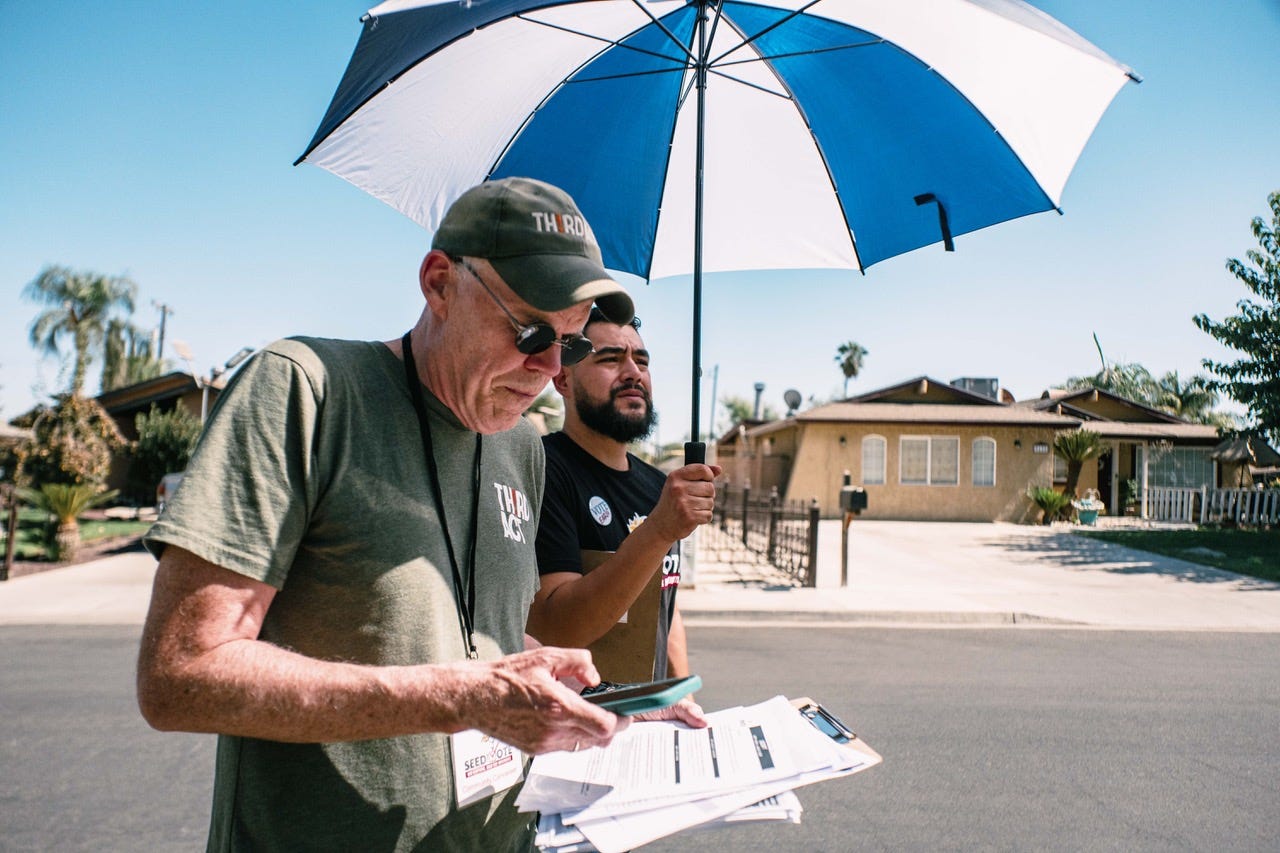
As Boeve said at the end of her interview with Greenberg, “this is not the moment to take a break, not before the midterms.” She’s right. Here’s a picture of me with Seed the Vote’s great organizer Ernie Flores, out in Bakersfield, CA doorknocking for Randy Villegas. If you’re wondering about the umbrella, it was 103 degrees, a record for the day, and a good reminder of why we’re doing this. I’m on to upstate New York today, Maine by Sunday, Michigan and Texas and on and on in the 24 days we have left. If you can figure out a way to help, do. (And if you can’t, Third Act has lots of canvasses and phone banks; we don’t check IDs, so even if you haven’t reached our magic age of 60, feel free to hop aboard).
And if you want one more reason to feel like it might be worth the fight, I give you a study published this week in the journal Ecology and Evolution with the excellent title Inferring the Abundance of an Island Megaherbivore From Semi-Structured Distance Sampling.
What it found was that the giant tortoises of Aldabra atoll in the Seychelles are…doing great. Important conservation measures have triumphed, and
The most recent survey, led by Seychelles Islands Foundation (SIF) and the University of Exeter, revealed there were approximately 180,000 tortoises living on the island. This is the highest figure ever recorded for the species and far exceeds the human population of Seychelles.
On we fight!
Subscribe to Our Newsletter
Get the latest CounterCurrents updates delivered straight to your inbox.
Bill McKibben is the Schumann Distinguished Scholar at Middlebury College and co-founder of 350.org and ThirdAct.org. His most recent book is “Falter: Has the Human Game Begun to Play Itself Out?.” He also authored “The End of Nature,” “Eaarth: Making a Life on a Tough New Planet,” and “Deep Economy: The Wealth of Communities and the Durable Future.”
Originally published by The Crucial Years
Why it is over
- No engagement data available from these sources; score uses mention signals only
Attention graph
Not enough history in this window yet. The engine measures every five minutes.
Timeline
- DetectedFirst detected (GDELT Global Knowledge Graph) source
- StateOver
single source and no mention for 24h
Where it started
How it spread
- Step 1News outletsGDELT Global Knowledge Graph13:00
Internet reaction
No social or community posts about this yet from the platforms we ingest.
What we know
- Nothing independently established yet.
What we don’t know
- Independent confirmation is missing; treat specifics as unverified
- Only one source so far
All sources (1)
Attention is measured from these mentions only. Platforms shown: News. We never invent signals for platforms we do not ingest.
Follow for your feed
Follow the topic or the people and places in this story and they shape your For you page. Kept in this browser only.