Multi-lane fast flow: What motorists need to know as Malaysia moves towards barrier-free tolling
Reported by two or more established outlets, or an official source.
What happened
KUALA LUMPUR, Oct 14 — Malaysia is moving towards multi-lane fast flow (MLFF), a tolling system that would eventually allow motorists to pay tolls without stopping at conventional toll plazas. (Malay Mail, 07:00)
Read the reporting
1 reportMulti-lane fast flow: What motorists need to know as Malaysia moves towards barrier-free tolling
KUALA LUMPUR, Oct 14 — Malaysia is moving towards multi-lane fast flow (MLFF), a tolling system that would eventually allow motorists to pay tolls without stopping at conventional toll plazas.
As part of that transition, two systems are now being introduced to motorists: PLUS’ JustGo and Touch ’n Go’s Titan Flow.
They are not quite the same thing.
JustGo is a digital toll payment system that uses automatic number plate recognition (ANPR) to identify a vehicle and charge the debit or credit card linked to the motorist’s account.
Titan Flow, meanwhile, is Touch ’n Go’s broader MLFF technology platform, combining Radio Frequency Identification (RFID), ANPR, Light Detection and Ranging (LiDAR) and artificial intelligence.
For now, motorists will encounter the technology mainly through Enhanced RFID lanes, rather than as a standalone service or a huge gantry on a highway called Titan Flow.
So how do these systems work, how can motorists use them, and what happens if something goes wrong?
JustGo is a digital toll payment system that uses automatic number plate recognition (ANPR) to identify a vehicle and charge the debit or credit card linked to the motorist’s account. — Picture by Sayuti Zainudin
JustGo
JustGo is essentially a camera-based toll payment system.
Once a vehicle is registered with JustGo, cameras at participating toll plazas read its number plate and match it to the motorist’s account.
The toll is then charged to the linked debit or credit card.
Motorists do not need an RFID tag specifically to use JustGo.
To sign up, users first download the JustGo app and register their phone number and email address.
They then have to complete the electronic Know Your Customer (e-KYC) verification using their MyKad, MyTentera or passport, including a real-time selfie and liveness check.
The next step is the electronic Know Your Vehicle (e-KYV), which requires the vehicle’s photographs and ownership documents.
A debit or credit card can then be linked to the account for toll payments.
Once everything is completed, the app should display the registered number plate and linked payment method, with the ANPR status shown as “ACTIVE”.
Users can register up to 10 vehicles.
Vehicles that are not registered in the user’s name can also be added, although supporting documents and manual approval may be required.
JustGo currently supports Class 1 vehicles, broadly covering passenger cars such as sedans, SUVs, MPVs and small pick-ups.
PLUS activated JustGo across participating toll plazas on its highways in August.
In its FAQ, it stated that JustGo is exclusively available at all lanes at all toll plazas on PLUS highways.
There are some location-specific exceptions, including the U-turn at the Tanjung Kupang Toll Plaza, while at the Bandar Cassia Toll Plaza, only RFID lanes are currently activated for ANPR.
The coverage is subject to change, so motorists should check the latest information from JustGo or PLUS before travelling.
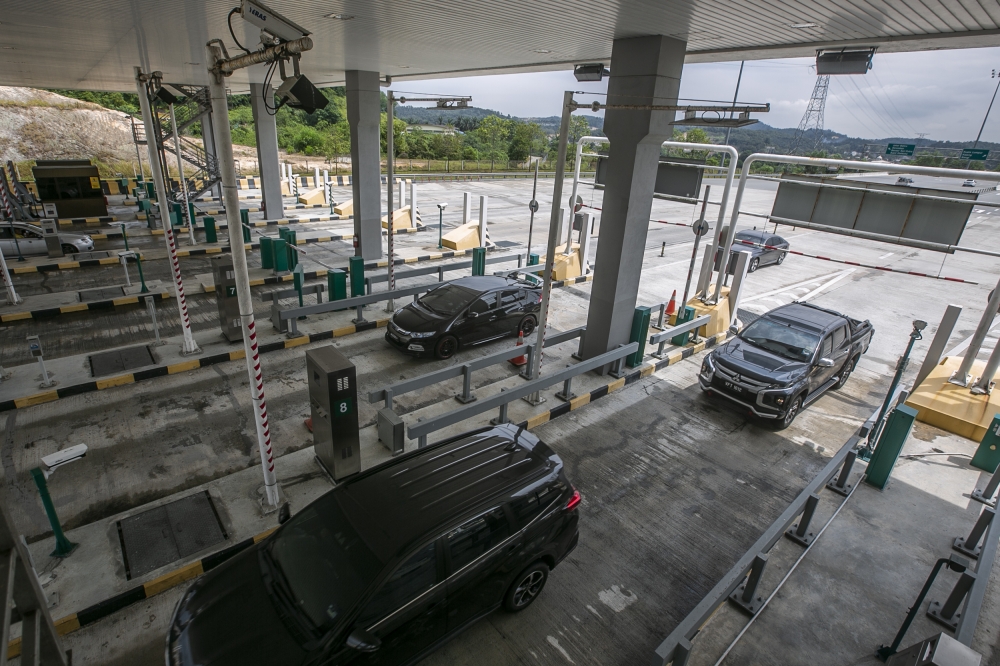
In normal operation, the process is simple: drive into a participating lane, the camera reads the number plate, the system matches the vehicle to the registered account and the toll is charged to the linked bank card.
In normal operation, the process is simple: drive into a participating lane, the camera reads the number plate, the system matches the vehicle to the registered account and the toll is charged to the linked bank card. — Picture by Hari Anggara
According to JustGo’s FAQ, motorists cannot simply pay cash at the exit if the linked card has insufficient funds.
It stated that drivers must ensure they have sufficient funds in their bank card before the start of their journey.
“If you are mid-way in your journey, kindly pull aside in a safe area i.e. a rest and relax area (R&R) to top-up your bank card safely,” the FAQ stated.
If the vehicle becomes stuck at a toll lane, motorists should use the intercom to seek assistance.
There is also a specific situation in which a JustGo user may see a Touch ’n Go eWallet deduction instead of a bank-card charge.
This can happen if the ANPR system fails to detect the vehicle at the previous entry point, meaning the toll cannot be charged to the linked bank card and is instead deducted from the linked Touch ’n Go eWallet.
Touch ’n Go describes Titan Flow as a next-generation MLFF platform that combines several technologies, including RFID, ANPR, LiDAR and artificial intelligence, together with open-payment capabilities. — Picture by Yusof Mat Isa
Titan Flow
Touch ’n Go describes Titan Flow as a next-generation MLFF platform that combines several technologies, including RFID, ANPR, LiDAR and artificial intelligence, together with open-payment capabilities.
In practical terms, however, motorists cannot currently download a “Titan Flow” app and start using it as a separate toll payment service.
Instead, elements of the technology are already being introduced through Enhanced RFID lanes.
Enhanced RFID still uses the physical Touch ’n Go RFID tag attached to the vehicle. Existing RFID tags can be used, meaning motorists do not need to obtain a special “Titan Flow” or “enhanced RFID” tag.
The basic process remains familiar to existing RFID users: obtain a Touch ’n Go RFID tag, register and activate it with the vehicle and link it to a Touch ’n Go eWallet account.
When the vehicle enters an Enhanced RFID lane, the system detects the RFID tag and the toll is deducted from the linked eWallet.
When the vehicle enters an Enhanced RFID lane, the system detects the RFID tag and the toll is deducted from the linked eWallet. — Picture by Hari Anggara
The important difference is that Enhanced RFID is part of the technology being developed towards MLFF, with additional detection and identification capabilities being tested alongside the existing RFID system.
It is just the same system as normal RFID, but the toll lane setup has been improved for faster, more reliable vehicle detection at higher speeds.
So these technological improvements could reduce the “ Reverse, Forward, InsyaAllah Detect ” problem at the toll booth.
For motorists, the easiest way to tell whether they are entering an Enhanced RFID lane is to look for the designated Enhanced RFID signage, including the gold star marking.
The first Enhanced RFID deployment was at the Dato Keramat Toll Plaza on the Ampang-Kuala Lumpur Elevated Highway (AKLEH), while another was subsequently introduced at the Putrajaya-bound toll plaza on the Maju Expressway (MEX).
Touch ’n Go has also announced plans for 10 more Enhanced RFID lanes by the end of 2026, covering highways including MEX, the Kajang Dispersal Link Expressway (SILK), Grand Sepadu, Guthrie Corridor Expressway (GCE) and the East Klang Valley Expressway (EKVE).
Unlike the long-term MLFF concept with no barriers, these are still designated toll lanes.
Motorists must continue to follow the lane markings and signage rather than assuming that every part of the highway has already become barrier-free. — Picture by Firdaus Latif
Motorists must therefore continue to follow the lane markings and signage rather than assuming that every part of the highway has already become barrier-free.
So, in simple terms, JustGo identifies your vehicle through its number plate and charges a linked debit or credit card.
Enhanced RFID identifies your vehicle through an RFID tag and deducts the toll from a linked Touch ’n Go eWallet.
Titan Flow is the wider technology platform that Touch ’n Go is developing for the eventual MLFF system, rather than a separate consumer app that motorists currently need to sign up for.
The two systems are part of Malaysia’s wider transition towards barrier-free tolling, but motorists do not currently have to choose between “JustGo” and “Titan Flow” as two competing nationwide payment systems.
For now, JustGo can be used at participating PLUS toll plazas where ANPR has been activated, while Touch ’n Go users can encounter the newer Titan Flow technology through designated Enhanced RFID lanes.
The eventual aim of MLFF is to remove the need for conventional toll lanes altogether, allowing vehicles to be identified and charged while continuing their journey.
Why it is new
- No engagement data available from these sources; score uses mention signals only
Attention graph
Timeline
- DetectedFirst detected (Malay Mail) source
Where it started
How it spread
- Step 1News outletsMalay Mail07:00
Internet reaction
No social or community posts about this yet from the platforms we ingest.
What we know
- Covered by 1 established outlet(s): Malay Mail
What we don’t know
- Independent confirmation is missing; treat specifics as unverified
- Only one source so far
All sources (2)
Attention is measured from these mentions only. Platforms shown: News. We never invent signals for platforms we do not ingest.
Follow for your feed
Follow the topic or the people and places in this story and they shape your For you page. Kept in this browser only.