Beyond the Pages, Beyond the Words
Only social or community posts, or a single source.
What happened
Reading is not merely about consuming stories; it is about allowing those stories to shape how we think, feel and understand the world, and eventually using those experiences to create something of our own. (Sarawak Tribune, 09:46)
Read the reporting
1 reportBeyond the Pages, Beyond the Words
Reading is not merely about consuming stories; it is about allowing those stories to shape how we think, feel and understand the world, and eventually using those experiences to create something of our own.
Drawing inspiration from every page
There is something about a good book that stays with us long after we have turned its final page. Sometimes, it is a sentence that changes the way we see life. At other times, it is a character whose struggles remind us of our own, or a story that leaves us questioning what we once believed.
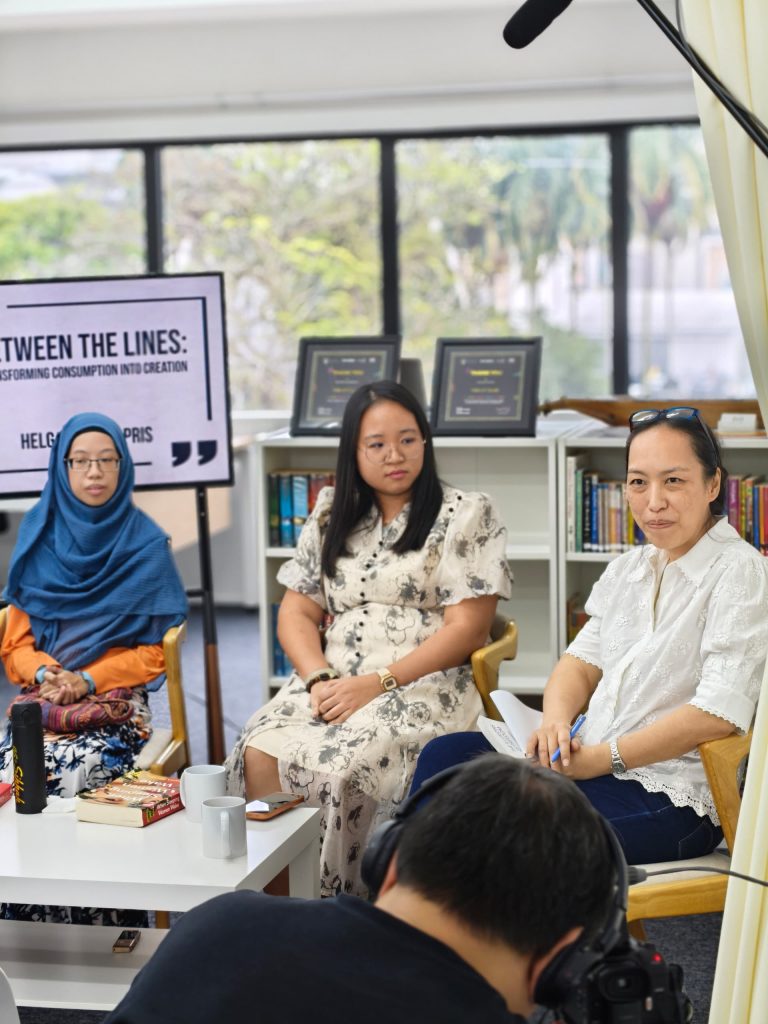
At a recent ‘RX: The Reader Experience’ fireside chat titled ‘Between the Lines: Transforming Consumption into Creation’, organised by The Lit Club by Subject Matter in Kuching, three writers — Sihhah, Pris and Helga — shared their reflections on how reading has shaped their lives and writing.
The three panellists remind the audience that reading can be a way to slow down and reconnect with oneself.
Recalling her younger days as an avid reader, local poetry writer Sihhah revealed that her father once questioned her love of novels. “Each time he saw me with a book, he would ask why I was reading something useless instead of studying.”
However, Sihhah explained that the novels she read offered more than just stories. Each page imparted valuable life lessons and helped her understand and navigate different emotions.
Although the three writers began their reading journeys with different books, they eventually found their way into writing, albeit in different fields. For writers, reading is more than a pastime. It is a way of gathering experiences, discovering different perspectives and finding the words to express what might otherwise remain unspoken.
Despite their differing reading preferences, the three panellists shared a common understanding: books can teach us things that formal education alone may not, offering lessons about human emotions, culture, history and the complexities of life.
A writer’s worldview
During the fireside chat, moderator Barry Barim observed that reading preferences often change as we grow older. As children, we may gravitate towards certain genres that no longer appeal to us later in life, eventually discovering new interests we never expected to develop.
The books we read, in a sense, grow with us. From Enid Blyton’s stories and the Twilight series to The Fault in Our Stars and Agatha Christie’s mysteries, each reading experience can spark inspiration and shape how we see the world.
Moderator Barry Barim
“There’s just something about a good book, especially one by Mitch Albom, that changes one’s perspective. It can also be thought-provoking, often leaving readers lying in bed asking themselves ‘why’,” said Pris.
To her, a good book can inspire and motivate through its words of encouragement. Echoing this sentiment, Sihhah said Days at the Morisaki Bookshop had taught her a similar life lesson: to get back up after falling down.
Such reflections have influenced how the three writers approach their own work.
Helga noted that writers who read can become more attuned to emotions because they are exposed to different experiences and perspectives through books. Reading also helps them learn how to express those emotions in words.
From consumption to creation
What begins with each turn of a page can eventually find its way onto another page, as readers become writers and the stories they consume inspire them to create their own.
For the three panellists, reading was not simply about following a plot or discovering what happens next. It was also about absorbing ideas, observing human behaviour and making sense of the world around them.
For Pris, reading allows her to step away from the demands of everyday life and immerse herself in another world, while discovering perspectives she might not otherwise encounter.
“Through reading, we pick up different words and learn to expand them into sentences, almost like a form of art. As our vocabulary grows, we can experiment with different ways of writing,” Pris said.
As a feature writer for Sarawak Tribune, reading had deepened her understanding of the many emotions and experiences people go through, helping her empathise more with the people she interviews.
For Helga, who writes for the independent research and writing blog CQ Journal, reading serves as a source of information that sparks her curiosity and drives her to explore topics further.
“While reading is an impulse, writing about it helps me understand what I have read. With a renewed perspective, I then find myself searching for new information and exploring different aspects of the subject,” she said.
Sihhah, who recently published her first poetry book, ‘Whispers of the Wind’, said reading had taught her how to write poetry despite having no formal education in writing. By drawing on the words she encountered in books, she learned through experience how to express herself through poetry.
Over time, these experiences found different expressions in their writing. Some drew inspiration from the emotions and relationships explored in novels, while others looked to history, culture and the changing world for ideas worth sharing.
Their journeys showed that writing does not always begin with a sudden flash of inspiration. Sometimes, it starts quietly — with a book that leaves a lasting impression, a character that feels familiar or a sentence that makes a reader pause and think.
When those impressions take root, they can inspire readers to pick up a pen and tell a story of their own.
Reading for a pause
Beyond the lessons they offer and the inspiration they provide, the three panellists also reminded the audience that reading can be a way to slow down and reconnect with oneself.
In a world where attention is constantly pulled in different directions by busy schedules and endless scrolling, picking up a book offers an opportunity to pause, reflect and spend time with one’s own thoughts.
For the three panellists, reading was not simply about following a plot or discovering what happens next, but also about absorbing ideas, observing human behaviour and making sense of the world around them.
For Pris, reading allows her to step away from the demands of everyday life and immerse herself in another world, while discovering perspectives she might not otherwise encounter.
“Sometimes, a good book does not need to provide all the answers; it simply needs to leave readers with something to think about,” she added.
Helga’s approach to reading encourages readers to remain curious. A book can be the starting point of a larger journey, leading to further questions, conversations and discoveries. By continuing to read and learn, readers can better understand the world around them and consider what is worth carrying forward.
Picking up a book offers an opportunity to pause, reflect and spend time with one’s own thoughts.
Sihhah encouraged those who may have lost the habit of reading to start with something they genuinely enjoy. There is no need to begin with a lengthy novel or a book considered intellectually challenging. Even a children’s book or a newspaper can be a starting point, as long as it sparks an interest in reading.
Ultimately, the journey from reader to writer does not happen overnight, nor does reading need to lead to a particular achievement. Sometimes, its value lies in the quiet moments it creates, the emotions it helps us understand and the questions that stay with us long after the book is closed.
Perhaps that is the beauty of reading: while a book may have a final page, the thoughts and possibilities it leaves behind do not have to end there.
Why it is new
- No engagement data available from these sources; score uses mention signals only
Attention graph
Timeline
- DetectedFirst detected (Sarawak Tribune) source
Where it started
How it spread
- Step 1News outletsSarawak Tribune09:46
Internet reaction
No social or community posts about this yet from the platforms we ingest.
What we know
- Covered by 1 established outlet(s): Sarawak Tribune
What we don’t know
- Independent confirmation is missing; treat specifics as unverified
- Only one source so far
All sources (1)
Attention is measured from these mentions only. Platforms shown: News. We never invent signals for platforms we do not ingest.
Follow for your feed
Follow the topic or the people and places in this story and they shape your For you page. Kept in this browser only.