Malaysia unveils six homegrown chips worth RM300m as it shifts from making to designing semiconductors
Reported by two or more established outlets, or an official source.
What happened
KUALA LUMPUR, Oct 16 — Malaysia today unveiled six homegrown semiconductor innovations with an estimated combined sales potential of RM300 million, as the government seeks to move the country beyond chip manufacturing into designing and owning its own technology. (Malay Mail, 17:22)
Read the reporting
3 reportsMalaysia unveils six homegrown chips worth RM300m as it shifts from making to designing semiconductors
KUALA LUMPUR, Oct 16 — Malaysia today unveiled six homegrown semiconductor innovations with an estimated combined sales potential of RM300 million, as the government seeks to move the country beyond chip manufacturing into designing and owning its own technology.
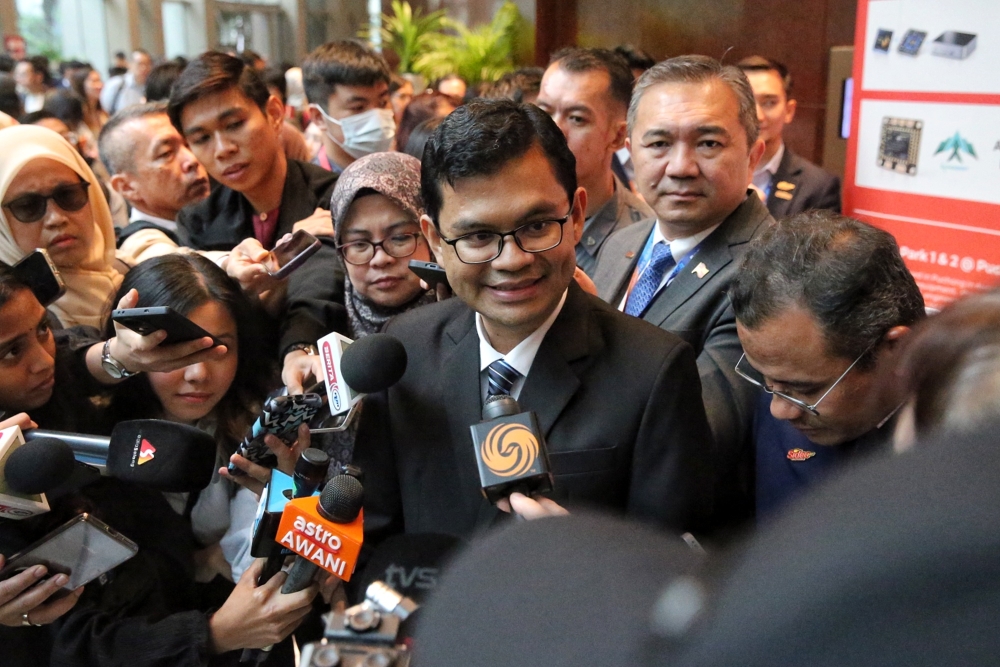
Economy Minister Akmal Nasrullah Nasir said the six innovations demonstrated the growing capabilities of Malaysian companies, although further work was needed to secure customers, meet industry qualification requirements and turn the designs into commercially successful products.
“The next milestone is to secure customer adoption, meet industry qualification requirements and scale these innovations into successful commercial products,” he said in his speech at the launch of the six chips at the Grand Hyatt here.
The innovations were developed by companies operating within the Malaysia Semiconductor IC Design Park, with applications ranging from artificial intelligence (AI) and automotive electronics to satellites and autonomous drones.
SkyeChip’s MARS1000 is an edge-AI processor intended for use in cameras, robots and factory systems, while MaiStorage’s aiDAPTIV+ provides storage solutions for AI personal computers and servers.
SiliconX unveiled what was described as Malaysia’s and Southeast Asia’s first homegrown field-programmable gate array (FPGA), a reprogrammable semiconductor device designed for industrial and automotive applications.
The other innovations are Infinecs’ Maxwell, an automotive-grade power regulator for vehicle electronics; Weeroc Space’s power controller chip for satellites and other space systems; and Alphaswift’s FC Mini flight controller for autonomous drones.
Akmal said Malaysia was building on its established strengths in semiconductor packaging, testing and related manufacturing activities, while expanding into integrated circuit (IC) design through partnerships, talent development and investment.
“Over the past decade, we have proven our expertise in testing, documentation and packaging. At the same time, looking at those strengths, Malaysia has embarked on collaboration with Arm Limited, for example, to gain access to IP design,” he told reporters after the event.
He said the government was also investing in talent development and working with industry partners to complete the semiconductor ecosystem, adding that turning the six designs into viable products would be a long journey.
Malaysia’s National Semiconductor Strategy aims to train and upskill 60,000 engineers, while the Arm On-Demand Training programme targets 10,000 Malaysian talents in specialised IC design skills over four years.
Akmal said the government also needed to develop markets for locally designed chips so that Malaysian products could attract more customers and encourage further investment in the industry.
“The effort is not just to create, but also to continue to build up markets so that what we produce will continue to open up space for additional companies to be interested in our chips,” he said.
Selangor Menteri Besar Datuk Seri Amirudin Shari said the two Malaysia Semiconductor IC Design Parks in Puchong and Cyberjaya housed 407 engineers across 20 companies, including Malaysian firms and international partners from Taiwan, France, Japan and Australia.
The Puchong park, which opened in August 2024, was almost full, while the Cyberjaya facility, launched in November 2025, was preparing to expand from one occupied floor to three, he said.
Amirudin said the development of local chip-design capabilities depended on bringing together talent, technology and capital.
He cited the Advanced Semiconductor Academy of Malaysia, which has trained around 850 engineers in collaboration with more than 100 universities, and the Ehsan Semiconductor Fund, which aims to raise RM100 million to invest in early-stage semiconductor start-ups and AI application companies.
Akmal also said federal and state governments needed to coordinate their efforts to strengthen Malaysia’s overall semiconductor ecosystem, rather than view investments in different states as competing initiatives.
Responding to a question about Sarawak’s recent unveiling of a locally designed gallium nitride chip, he said each state could contribute different strengths and expertise to the industry.
“For us as a small country, definitely we need to rely on each other’s strengths,” he said, adding that investments in individual states could create value nationally if supported by better coordination.
“We need to further coordinate so that everyone will actually amplify our strength as a nation.”
Why it is rising
- Current hour is 1.7 standard deviations above this event's own baseline
- Spread across News, YouTube
- 4 independent sources, 2 new in the last hour
- Driven by news coverage (4 mainstream mentions in 6h) with little social discussion so far
- No engagement data available from these sources; score uses mention signals only
- Discussed in English, Bahasa Malaysia
Attention graph
Timeline
Where it started
How it spread
- Step 1News outletsMalay Mail17:22
- Step 2YouTube (mainstream)Astro AWANI (YouTube)18:32 · +71 min
Internet reaction
No social or community posts about this yet from the platforms we ingest.
What we know
- Covered by 4 established outlet(s): Astro AWANI (YouTube), Astro Awani (BM), Berita Harian, Malay Mail
What we don’t know
- No open questions flagged by the rules.
All sources (4)
Attention is measured from these mentions only. Platforms shown: News · YouTube. We never invent signals for platforms we do not ingest.
Follow for your feed
Follow the topic or the people and places in this story and they shape your For you page. Kept in this browser only.