Putrajaya ‘not discounting’ letting refugees work in sectors with critical labour shortages, says home minister
Only social or community posts, or a single source.
What happened
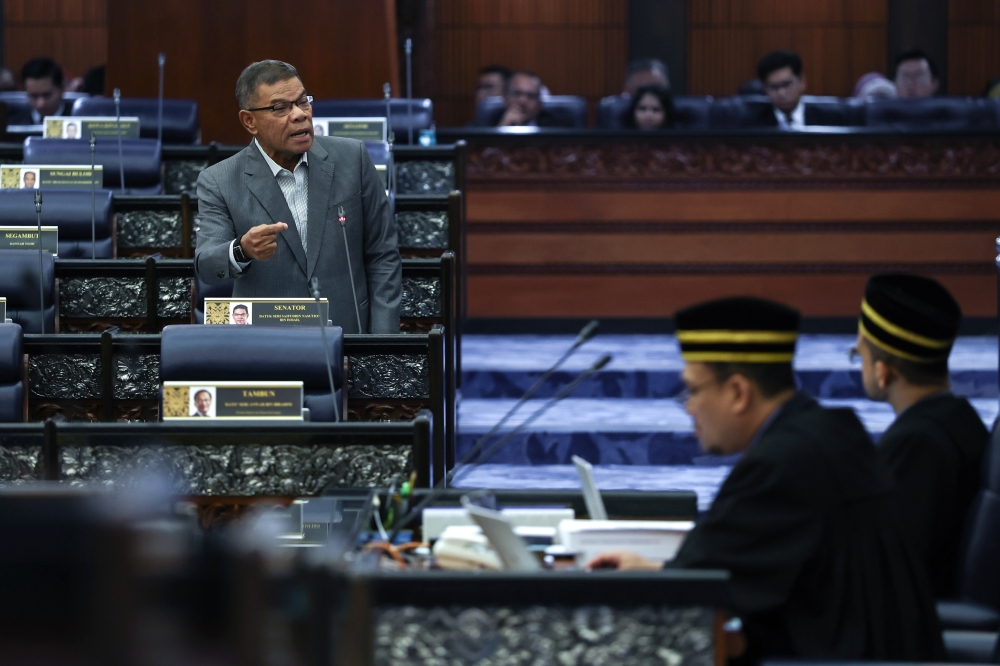
KUALA LUMPUR, Oct 13 — Putrajaya is “not discounting” proposals to legalise work for refugees in sectors with a critical labour shortage, Home Minister Datuk Seri Saifuddin Nasution told Parliament’s House of Representatives this morning. (Malay Mail, 13:09)
Read the reporting
1 reportPutrajaya ‘not discounting’ letting refugees work in sectors with critical labour shortages, says home minister
KUALA LUMPUR, Oct 13 — Putrajaya is “not discounting” proposals to legalise work for refugees in sectors with a critical labour shortage, Home Minister Datuk Seri Saifuddin Nasution told Parliament’s House of Representatives this morning.
The idea comes as several key economic sectors face persistent labor shortages and rely heavily on foreign workers.
These industries typically involve high levels of manual, physical, or shift-based labor — often categorised as dirty, dangerous, and demanding, or “3D Jobs”.
“If only we could collect the data of these 225,000 people, then separate those who fall within a productive age range, ages 20, 25, 30 are still productive,” Saifuddin said during Question Time.
“Once filtered, we would have their data. So our intention is that workforce requirements wouldn’t necessarily have to be sourced from outside... I do not rule out the possibility that the path is heading in that direction to meet the real workforce needs in front of us.”
Saifuddin then presented a hypothetical example.
“Suppose Pasir Gudang has an oil palm plantation that needs 100 workers. There are two choices: either recruit from Bangladesh and pay all kinds of costs, or check against our refugee registration data of those who are already here, for instance. That is the decision we will make for now,” he said.
Several key sectors of the domestic economy (plantation, manufacturing, construction, services) rely heavily on foreign workers, but recruiting them can be expensive given the administrative costs and government-imposed levies.
Officials estimate put the number of foreign labourers in the Malaysia around 2.2 million at any given time, mostly from poorer countries like Bangladesh and Nepal.
Some migrant labour rights groups said the costs of hiring foreign workers have inadvertently turned the importation into “an industry” on its own, making workers susceptible to exploitation from transnational syndicates that often operate with the backing of corrupt officials.
Employers pay annual government levies that can range from RM640 a year for plantations, and up to RM1,850 a year for manufacturing and services. This is on top of other costs such as pass fees, medical screenings (FOMEMA), mandatory EPF and Socso contributions, as well as mandatory housing.
Malaysia is not a signatory to the 1951 UN Refugee Convention. Because of this, refugees are legally classified as “undocumented migrants” or “illegal immigrants” under the Immigration Act 1959/63, leaving them vulnerable to arrest, detention, and extortion despite holding UNHCR cards.
But past administrations had previously attempted pilot schemes for refugee work rights, including allowing Rohingya refugees to work in the plantation and manufacturing sectors, although some initiatives reportedly struggled with issues such as inadequate regulatory frameworks, unsuitable job placements and poor worker retention.
Why it is new
- No engagement data available from these sources; score uses mention signals only
Attention graph
Timeline
- DetectedFirst detected (Malay Mail) source
Where it started
How it spread
- Step 1News outletsMalay Mail13:09
Internet reaction
No social or community posts about this yet from the platforms we ingest.
What we know
- Covered by 1 established outlet(s): Malay Mail
What we don’t know
- Independent confirmation is missing; treat specifics as unverified
- Only one source so far
All sources (1)
Attention is measured from these mentions only. Platforms shown: News. We never invent signals for platforms we do not ingest.
Follow for your feed
Follow the topic or the people and places in this story and they shape your For you page. Kept in this browser only.