A Tapestry of Culture, Nature
Only social or community posts, or a single source.
What happened
Inspired by a novel about Vietnam’s troubled past, a trip to the country’s north reveals breathtaking landscapes, rich culture, traditional crafts and distinctive cuisine. From the heights of Mount Fansipan to the busy streets of Hanoi, the journey offers memorable experiences and surprising similarities with home in Sarawak. (Sarawak Tribune, 06:30)
Read the reporting
1 reportA Tapestry of Culture, Nature
Inspired by a novel about Vietnam’s troubled past, a trip to the country’s north reveals breathtaking landscapes, rich culture, traditional crafts and distinctive cuisine. From the heights of Mount Fansipan to the busy streets of Hanoi, the journey offers memorable experiences and surprising similarities with home in Sarawak.
Beyond pho and pagodas: Vietnam mesmerises
My latest trip to Vietnam was inspired by a novel I had recently read, “Dust Child” by Nguyễn Phan Quế Mai.
Set in war-torn Vietnam in the late 1960s, the novel is a haunting tale of love, loss and resilience. It is the kind of story that lingers long after the last page, and perhaps it is stories like these that draw visitors like me to this Southeast Asian nation.
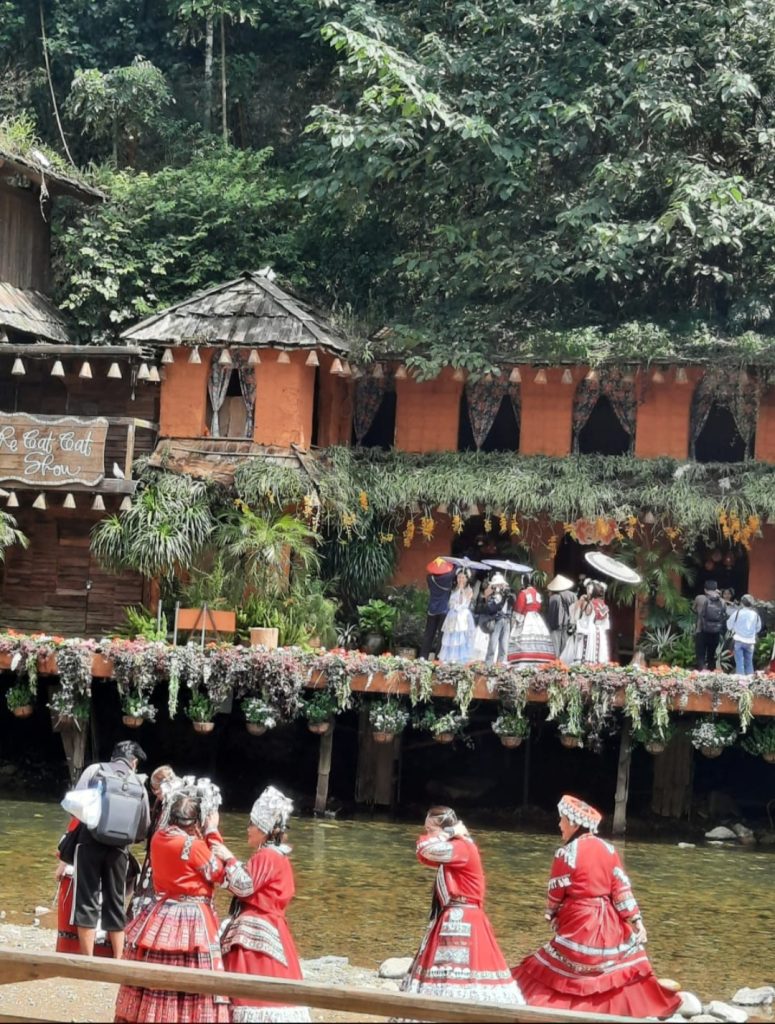
Tourists don traditional Black H’mong costumes at Cat Cat Village, Sapa.
Sidewalk cafe patrons wait for the train to arrive along Hanoi Train Street.
Beyond the scars of its poignant history lies a country rich in culture, authenticity in its food, and beauty in its countless landscapes and people — a place where the past and present live side by side.
This time, my daughter, Angeline, and I chose to explore northern Vietnam, joining a sporting group of fellow Malaysian tourists led by our equally awesome tour leader, Clifton Teh, with Hanoi as our base.
From Hanoi, we set out to explore the treasures of the north.
Our journey took us to the breathtaking Halong Bay, a UNESCO World Heritage Site, and onward to the misty highlands of Sapa — home to Mount Fansipan, the quaint Cat Cat Village, and the thrilling Rong May Glass Bridge.
Not far from Sapa lies the China-Vietnam border, where the Kunming-Sapa crossing is separated by a bridge that makes for a perfect photo spot.
The highlight, though, was Mount Fansipan. At 3,143 metres, the “Roof of Indochina” stands above all. We ascended by cable car, then tackled the final flight of steps to the summit. There, at the top of Indochina, we unfurled the Jalur Gemilang and cheered, “Malaysia Boleh!” — tired, exhilarated and immensely proud.
We then headed south to Ninh Binh, where we drifted by boat through the serene limestone karst landscape of Trang An Grottoes before standing in awe before the towering, 13-storey Bai Dinh Pagoda, the tallest in the ASEAN region.
In Hanoi, we sat at a tiny sidewalk cafe on Hanoi Train Street in the Old Quarter, waiting for the train to pass through. Minutes before it thundered through the narrow, 0.85km stretch of active track, vendors scrambled to pull in their stools, awnings and wares. Built by the French in 1902, this historic line runs behind Hanoi Railway Station along Phùng Hưng and Điện Biên Phủ, with several trains passing through daily.
Visitors marvel at the towering 13-storey Bai Dinh Pagoda.
A decorative tree house draws visitors on the mountain trail to Cat Cat Village, Sapa.
We also toured the old part of the city, visiting 36 Ancient Street and the Temple of Literature, which was founded in 1070 to honour Confucius.
Interestingly, this architectural landmark, an official cultural symbol of Hanoi, is printed on the back of the 100,000 VND (Vietnamese dong) banknote.
For Angeline, her second trip to Vietnam — this time to the north — was a journey of nature, culture and reflection.
“Being a nature lover, the areas we toured were all mesmerising and embracing,” she said.
She singled out Halong Bay, the UNESCO World Heritage Site famous for its thousands of limestone islands, noting that it was also the filming location for the Hollywood blockbuster “Kong: Skull Island”.
“The feeling of awe continued to grow as we were climbing the steps up Mount Fansipan and rowing along the river in Ninh Binh, surrounded by towering karsts,” she said.
Halong Bay, a UNESCO World Heritage Site.
A boatwoman takes tourists to the Trang An Grottoes along the Ninh Binh river.
Angeline, who has an honours degree in Tourism and Hospitality, also drew parallels between Vietnam and home.
“The vibrant, colourful costumes of the hill tribes (in Sapa) reminded me of home — their palette and patterns bearing an uncanny resemblance to our Sarawak Bidayuh costumes,” she observed, adding that the trip was also a lesson in perspective.
At the traditional Cat Cat Village, nestled in the misty valley just outside Sapa, Black H’mong artisans sat hunched over their work — linen weaving, indigo dyeing, silver carving and wax painting on traditional clothing.
To reach it, we had to descend a steep paved path and navigate numerous stone steps into the valley, followed by an uphill trek back. Along the way, the path came alive with colour, with stalls lining the route and displaying embroidered H’mong handicrafts.
And then there were the Cat Cat waterfall, stream, bamboo water wheels for processing rice and carrying out daily tasks, cultural shows, and photo opportunities in traditional costumes by the banks.
The entrance to the Temple of Literature in Hanoi.
It felt strangely familiar, reminding one of Sarawak Cultural Village back home — the same spirit, a different soul.
And, of course, there were the signature Vietnamese culinary delights — pho, the aromatic soup of broth, rice noodles, herbs and meat; banh mi, the humble yet flavourful short baguette; and egg coffee.
For the exquisite egg coffee experience, our tour leader, Teh, brought us to Dinh13 cafe in the capital — a place described as a living time capsule, where old Hanoi lingers in every sip, every creaky stair and every melody humming from the speakers.
The phrase “small women, small house, small road, small country”, according to Teh, is a popular, light-hearted cultural observation often used by locals and travellers to capture the unique essence of traditional Vietnamese life.
As we travelled, the saying came to life. Vietnamese ladies have petite frames, which are celebrated culturally and are perfectly complemented by the elegant, form-fitting national garment, the áo dài.
Teh pointed out the small roads and highways, flanked by equally small houses that looked almost like miniatures from the street. These ultra-narrow homes, often measuring only 2 to 4 metres wide but rising several storeys high, are said to be a legacy of French colonial times, when property tax was calculated based on frontage width.
A LOVE sign makes a perfect photo backdrop.
On a map, Vietnam curves like a thin, elongated ‘S’.
The narrow alleyways and small roads, on the other hand, function as extensions of the home itself. In Hanoi, traffic flow, especially during peak hours, is very chaotic. We were advised to avoid the city centre during that time.
Then there is the geography itself. On a world map, Vietnam — with a population of 102 million and stretching roughly 1,650km from north to south — curves like a thin, elongated “S”.
Why it is new
- No engagement data available from these sources; score uses mention signals only
Attention graph
Timeline
- DetectedFirst detected (Sarawak Tribune) source
Where it started
How it spread
- Step 1News outletsSarawak Tribune06:30
Internet reaction
No social or community posts about this yet from the platforms we ingest.
What we know
- Covered by 1 established outlet(s): Sarawak Tribune
What we don’t know
- Independent confirmation is missing; treat specifics as unverified
- Only one source so far
All sources (1)
Attention is measured from these mentions only. Platforms shown: News. We never invent signals for platforms we do not ingest.
Follow for your feed
Follow the topic or the people and places in this story and they shape your For you page. Kept in this browser only.