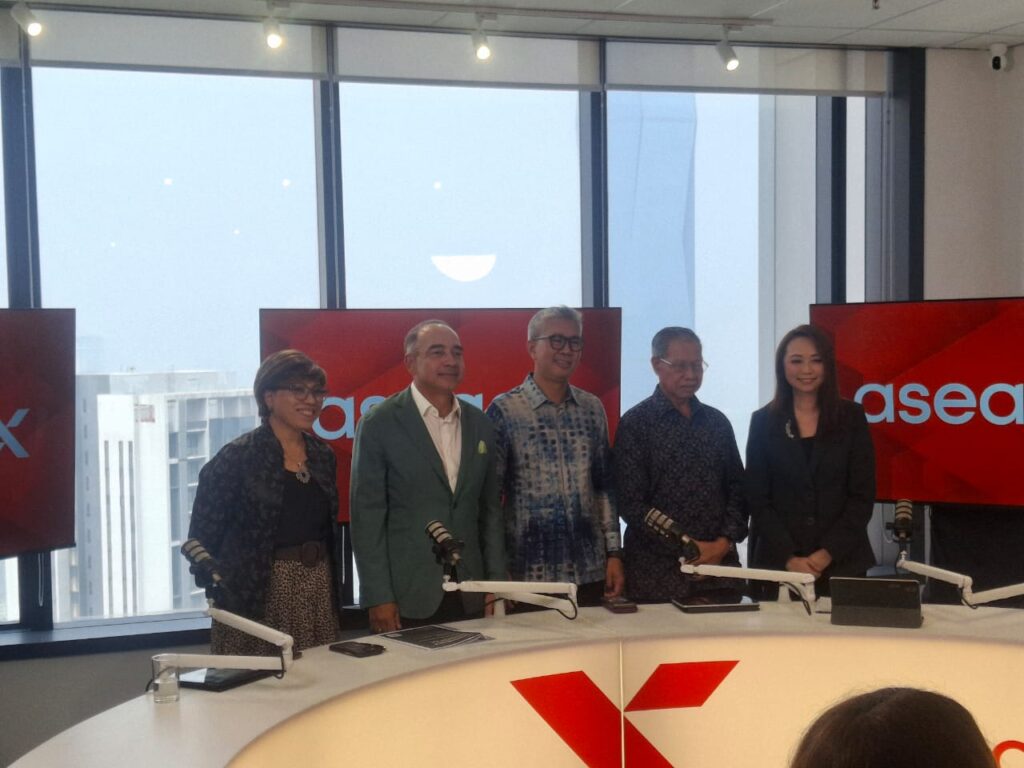
Asean overpromised economic integration, failed to deliver on 2015 vision: Nazir Razak
Only social or community posts, or a single source.
What happened
KUALA LUMPUR – Asean has fallen short of its promise to establish a single production base with the free movement of capital, goods and skilled labour by 2015, having overpromised the extent of economic integration it could achieve, said Tan Sri Nazir Razak. (Scoop, 17:59)
Read the reporting
1 reportAsean overpromised economic integration, failed to deliver on 2015 vision: Nazir Razak
KUALA LUMPUR – Asean has fallen short of its promise to establish a single production base with the free movement of capital, goods and skilled labour by 2015, having overpromised the extent of economic integration it could achieve, said Tan Sri Nazir Razak.
Speaking at the inaugural AseanX forum today, the Iklas Capital founding partner and chairman said the bloc had raised expectations among businesses and the public through its Asean Economic Community (AEC) vision but failed to deliver on its commitments.
“The problem started in 2007 when they said by 2015 the Asean Economic Community will be single production-based, free movement of capital, trade and skilled labour,” the former Asean-BAC Malaysia chairman said.
Nazir added the AEC was delayed by a year, and when it was celebrated in 2016, it fell short of what had originally been promised.
“Asean did not deliver what was promised,” he said, adding that businesses such as CIMB had expanded across the region based on those expectations, only to find that the level of integration envisioned had not materialised.
He said Asean must be honest about its shortcomings instead of celebrating progress without addressing the underlying problems.
The forum heard that despite the removal of 99% of tariffs between member states, intra-Asean trade accounted for only 22.5% of the bloc’s total goods trade in 2024.
This remains below the 40% potential cited through an ASEAN+3 Macroeconomic Research Office (AMRO) projection, highlighting the gap between existing trade levels and the benefits that deeper integration could deliver.
Former international trade and industry minister Tengku Datuk Seri Zafrul Abdul Aziz said the persistence of non-tariff barriers, protection of domestic industries and restrictions on talent mobility continued to hamper regional trade, despite progress in reducing tariffs.
He also pointed to significant differences in economic development among member states, making it difficult to establish common policies that accommodate the interests of all countries.
Former Asean Economic Community Blueprint drafting committee chairman Tan Sri Dr Rebecca Fatima Sta Maria said Asean had deliberately chosen not to replicate the European Union's model, opting instead for a gradual approach to integration based on consensus and confidence-building.
However, she said the bloc must now reconsider whether its existing structures remain suitable for today's economic challenges, particularly as trade, geopolitics, digitalisation and environmental issues increasingly overlap.
Rebecca also questioned the effectiveness of Asean's three-pillar structure, arguing that issues such as the digital economy and inclusivity could not be addressed effectively in separate policy compartments.
She said Asean had made progress through years of negotiations but had become too comfortable with its achievements instead of pushing ahead with deeper integration.
Nazir said the problem extended beyond policy design to the implementation of initiatives already agreed upon by member states.
Citing the proposed Asean Business Entity (ABE), which aims to facilitate the movement of people and provide certain privileges to qualifying companies operating across the region, he said the initiative had received broad support but struggled to progress beyond the announcement stage.
He said the proposal had also encountered difficulties because an initiative intended to benefit Asean as a whole had become associated too closely with Malaysia.
“It's an Asean idea, it's good for Asean, but it very quickly became Malaysia's idea,” he said, adding that this had made some member states reluctant to pursue it.
Nazir also criticised the Asean Business Advisory Council, saying its members should do more to persuade their respective governments to support and implement regional initiatives rather than simply participate in meetings.
He said the Asean Secretariat also needed to improve coordination between its leadership and working-level officials to ensure agreed proposals were properly communicated and executed.
At the institutional level, Nazir called for a stronger Asean Secretariat and greater continuity beyond the bloc's rotating annual chairmanship, which he said could disrupt long-term projects as priorities change from one year to the next.
He compared the arrangement to a company whose chairman changes every year, leaving the secretariat responsible for continuity but without sufficient authority to ensure progress.
Former Asean secretary-general Ambassador Ong Keng Yong agreed that the bloc should prioritise implementing existing agreements instead of continually introducing new initiatives.
He said Asean could also pursue integration at the sub-regional level, allowing groups of countries to overcome implementation challenges and demonstrate practical results before expanding successful approaches across the bloc.
Nazir said Asean must confront these weaknesses as global economic fragmentation creates an opportunity for Southeast Asian countries to strengthen regional cooperation and make the bloc a more attractive partner for external economies.
“Asean must stop being so nice to each other because when they're too nice to each other, they don't talk. They don't address issues,” he added.
He said a more candid assessment of Asean's shortcomings, coupled with stronger institutional coordination and sustained political commitment, was necessary to turn the bloc's economic potential into tangible benefits for businesses across Southeast Asia. - October 16, 2026
The post Asean overpromised economic integration, failed to deliver on 2015 vision: Nazir Razak appeared first on Scoop .
Why it is new
- No engagement data available from these sources; score uses mention signals only
Attention graph
Timeline
- DetectedFirst detected (Scoop) source
Where it started
How it spread
- Step 1NewsScoop17:59
Internet reaction
- Asean overpromised economic integration, failed to deliver on 2015 vision: Nazir Razaku/Keran Raj · Scoop · 17:59 · EN
What we know
- Nothing independently established yet.
What we don’t know
- No established news outlet has reported this yet; details come from social or community posts
- Independent confirmation is missing; treat specifics as unverified
- Only one source so far
All sources (1)
Attention is measured from these mentions only. Platforms shown: News. We never invent signals for platforms we do not ingest.
Follow for your feed
Follow the topic or the people and places in this story and they shape your For you page. Kept in this browser only.