When everyone became an expert
Only social or community posts, or a single source.
What happened
I have noticed that you do not have to study something for very long before someone is willing to explain it to you with complete confidence. (Sarawak Tribune, 06:00)
Read the reporting
1 reportWhen everyone became an expert
I have noticed that you do not have to study something for very long before someone is willing to explain it to you with complete confidence.
A few years ago, this might have required an actual qualification. These days, apparently, all you need is a phone, an internet connection and enough confidence to press “post”.
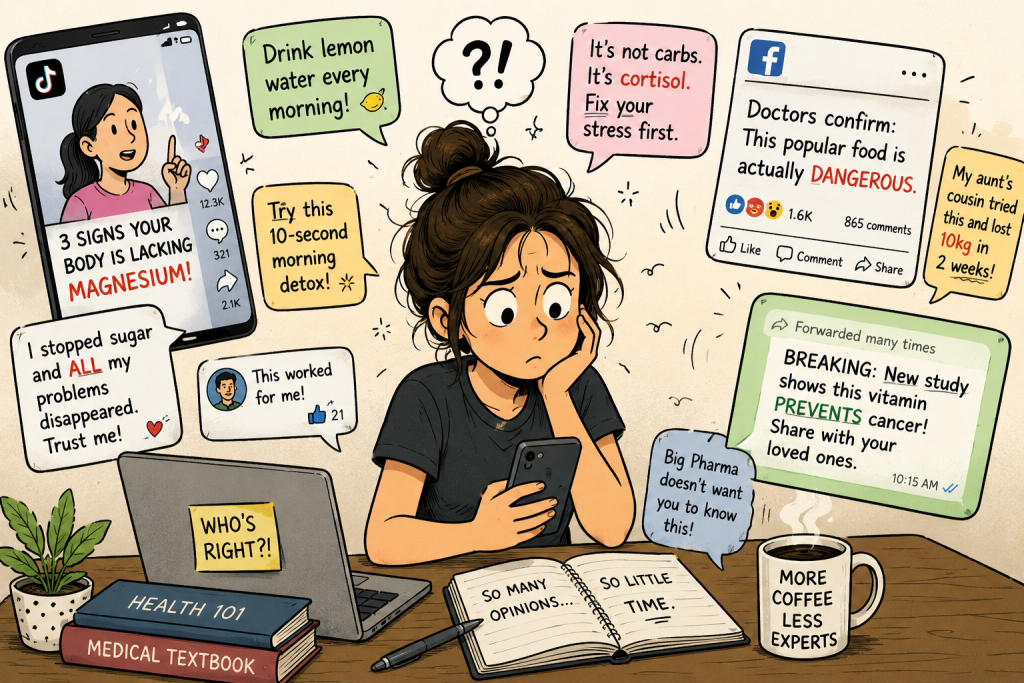
Mention a health problem and someone will have an answer. Say you have been feeling tired and somebody will tell you that you are probably lacking something. Mention that you are not sleeping well and suddenly there is advice about magnesium, vitamins, sunlight, breathing exercises, cold showers and whatever else the internet has discovered this week.
TikTok is particularly impressive. You can open the app looking for a recipe and, 20 minutes later, find yourself watching someone explain why you are tired, bloated, overweight and possibly deficient in three minerals you had never heard of before.
It is quite an achievement.
Facebook has its own version of this phenomenon. Someone shares a post about a particular food being dangerous, someone else shares another saying it is actually one of the healthiest foods you can eat, and before long, the family group chat has become an international medical conference.
Nobody has brought a medical textbook.
Nobody has brought a doctor.
Nobody, as far as I know, has even been invited to medical school.
But everyone has brought an opinion.
Of course, plenty of people online genuinely know what they are talking about. Doctors, researchers, lawyers, teachers and other professionals use social media to explain complicated subjects, and sometimes they do it remarkably well. The internet has made it possible to learn things that would once have required finding a book, attending a lecture or, in my case, admitting that I have absolutely no idea what I am looking at.
The problem is that the person giving the advice can be difficult to distinguish from the person who simply watched somebody else giving advice.
They can both have a camera. They can both speak confidently. They can both stand in front of a bookshelf. And if one of them uses enough complicated words, we may never know the difference.
Then come the comments.
“This worked for me.”
“My friend tried it.”
“I have been doing this for years.”
This image is generated by ChatGPT and intended for educational and illustrative purposes only. It does not depict real individuals or actual events.
There is something fascinating about how quickly personal experience can become evidence. Someone did something once, felt better afterwards and suddenly we have a treatment plan.
This is probably where being a journalist has made me rather annoying. I tend to ask questions. Where did that information come from? Who said it? Was there an actual study? Is that really what they said? And occasionally, most inconveniently of all, “Are we sure?”
These are not always popular questions, particularly when everyone else has already decided what happened.
Information also has a funny way of changing as it travels.
Someone watches a TikTok and tells a friend. The friend remembers the interesting part. Someone posts it on Facebook. Another person sends it to WhatsApp. By the time it reaches the family group, the original expert has become “a doctor”, the doctor has become “a scientist” and the original three minute video has somehow produced seven new facts.
Nobody knows where the seventh fact came from.
But everyone knows it is true.
The same thing happens with news. Someone reads a headline and immediately knows what happened. Someone else reads another headline and immediately knows the first person is wrong. Soon two people who have not actually read the article are arguing about an event neither of them witnessed.
I have seen enough of this in journalism to know that the first version of a story is rarely the whole story. There are usually details, questions and somebody who knows something the rest of us do not.
Which, really, is rather humbling.
Because I do not know everything either.
In fact, one of the things journalism has taught me is how much I do not know. You can walk into an interview thinking you understand a subject reasonably well and leave wondering how you managed to misunderstand so much.
That is not necessarily a bad thing. It is actually quite interesting.
Every now and then, however, I meet someone who seems to know everything.
They know what is wrong with the economy. They know what is wrong with the government. They know what is wrong with the healthcare system. They know exactly what causes every illness. They know what everyone else should be doing.
And they have usually discovered all of this while scrolling through their phone.
I find this remarkable because I can barely decide what to have for dinner.
Perhaps I am doing life incorrectly.
Maybe I should stop asking questions and start watching more TikToks.
Think of the time I could save. Why spend years studying a subject when someone has already explained it in 47 seconds? Why read an entire article when the comments section has already reached a unanimous conclusion? Why consult an expert when a person with excellent lighting and 300,000 followers has already pointed at some words on a screen and told us what is happening?
There is something wonderfully absurd about it.
We have more information available to us than any generation before us, yet we also seem to have developed an extraordinary ability to become certain very quickly.
Perhaps that is simply human nature.
We like answers. We like being right. And we especially like being right in front of other people.
I am not immune to it either. I have had moments when I have confidently thought I understood something, only to discover later that I had been completely wrong.
It happens.
The difference is that I now find being wrong considerably less embarrassing than pretending I knew something all along.
Besides, if there is one thing the internet has taught us, it is that there will always be somebody more confident than us.
There will always be someone with a theory, someone with a video, someone with a screenshot and someone who knows a friend who knows someone who supposedly knows the truth.
And if none of them know, there is always another app.
So perhaps I should stop worrying about whether everyone has suddenly become an expert. Maybe this is simply the world we live in now.
I will continue asking questions.
Someone else will continue answering them.
And if nobody knows the answer, I am sure someone on TikTok will confidently invent one.
DISCLAIMER :
The views expressed here are those of the writer and do not necessarily represent the views of Sarawak Tribune.
Why it is new
- No engagement data available from these sources; score uses mention signals only
Attention graph
Timeline
- DetectedFirst detected (Sarawak Tribune) source
Where it started
How it spread
- Step 1News outletsSarawak Tribune06:00
Internet reaction
No social or community posts about this yet from the platforms we ingest.
What we know
- Covered by 1 established outlet(s): Sarawak Tribune
What we don’t know
- Independent confirmation is missing; treat specifics as unverified
- Only one source so far
All sources (1)
Attention is measured from these mentions only. Platforms shown: News. We never invent signals for platforms we do not ingest.
Follow for your feed
Follow the topic or the people and places in this story and they shape your For you page. Kept in this browser only.