World Post Day: The building that keeps Kuching connected
Only social or community posts, or a single source.
What happened
From handwritten letters and telegrams to parcels and five-digit postcodes, Kuching’s General Post Office has been part of the city’s story for nearly a century. Its enduring presence reflects how one simple idea — staying connected — has evolved with the times. (Sarawak Tribune, 12:21)
Read the reporting
1 reportWorld Post Day: The building that keeps Kuching connected
From handwritten letters and telegrams to parcels and five-digit postcodes, Kuching’s General Post Office has been part of the city’s story for nearly a century. Its enduring presence reflects how one simple idea — staying connected — has evolved with the times.
93000: An address with a history
There are probably few buildings in Kuching that make such a striking contrast with the world around them.
Across the road, Plaza Merdeka bustles with shoppers, cars stream along Jalan Tun Abang Haji Openg and smartphones light up in the hands of people moving through the city.
Then there is the General Post Office.
With its long colonnaded frontage, semi-circular arches and imposing Corinthian columns, the white building looks as though it has wandered into modern Kuching from another century.
In a way, it has.
Built in 1931 during the reign of the third and final White Rajah, Charles Vyner Brooke, the building has been part of Kuching’s cityscape for almost a century. Designed by Irish-born architect Denis Santry of Singapore-based Swan and Maclaren, it is one of the city’s most distinctive examples of neo-classical architecture.
And unlike many old buildings that have survived only as monuments to another era, this one has continued to serve a practical purpose.
It is still a post office. That may be the most interesting thing about it.
But the site itself had an earlier life. Before the present building was constructed, it was occupied by a police station and the Rajah’s stables, where horses were kept for the Rajahs, senior officials and other prominent figures.
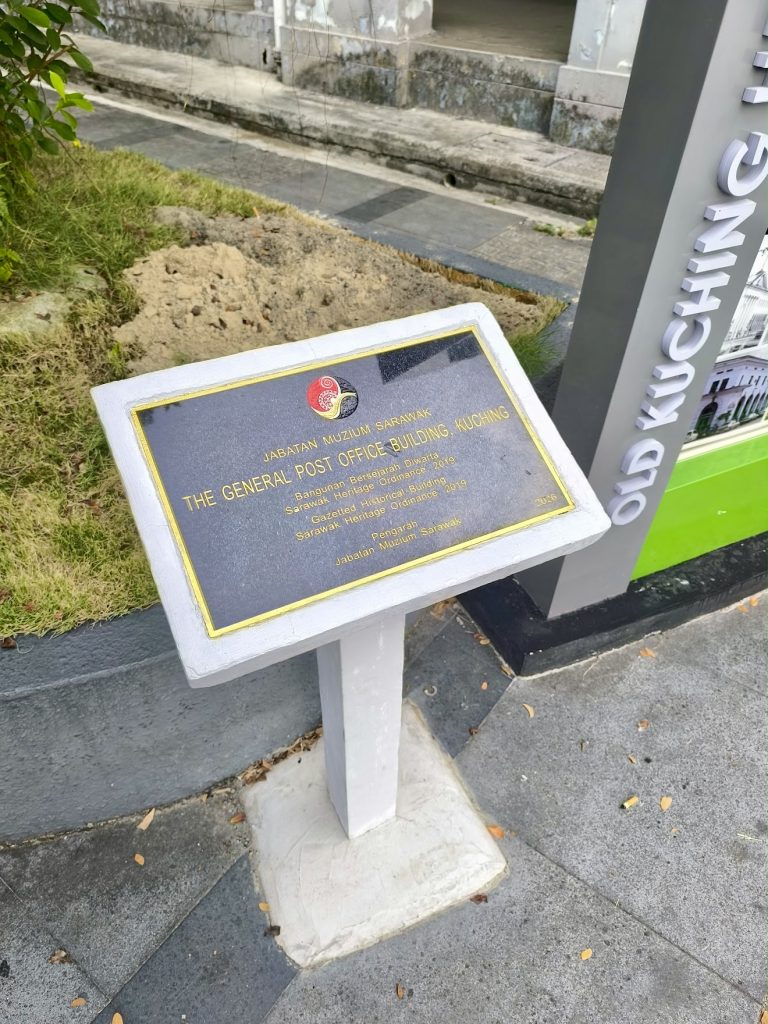
The General Post Office was gazetted as a historical building in 2019, recognising its architectural and heritage significance to Kuching. Photo: Yuuki Toono | Google Reviews
A building made to be noticed
The General Post Office was not designed to blend quietly into its surroundings.
Ten tall Corinthian columns, each rising about 30 feet, dominate the front entrance. Semi-circular arches, decorated capitals and friezes add to the grandeur, while a deep parapet conceals the pitched roof behind the facade. The result is a building that looks as though it belongs to a much earlier era than its 95 years might suggest.
Sarawak Tourism Board describes it as the only building in Sarawak with this particular neo-classical treatment and Corinthian columns. It has also remained in continuous use as the General Post Office since its completion, making it unusual not just for its architecture but for the role it has retained.
Its architect, Santry, was responsible for several important buildings in the region through Swan and Maclaren, the Singapore architectural practice behind the design. The firm also worked on St Thomas’ Cathedral in Kuching, another prominent building within the city’s historic core.
The post office therefore belongs to a particular moment in Kuching’s development — one in which public buildings were not merely functional structures but statements about the growing city.
But the grandeur of the building also reflected the importance of what happened inside. At a time when distance could make news feel a long way away, the post office was one of the places that helped bring people and places closer.
Before messages became instant
Imagine Kuching before WhatsApp, email and online parcel tracking.
There were no blue ticks to tell you that a message had been read. No instant photographs from the other side of the world. No notification announcing that a parcel had arrived at a collection point.
News travelled differently.
Letters had to be written, addressed, stamped and physically carried. A telegram could bring urgency, but even that belonged to a world in which distance could still be felt.
The post office was therefore more than somewhere to send an envelope.
It was a point of connection.
The General Post Office’s tall Corinthian columns, arches and ornate details reflect the grand architecture of its era. Photo: Yuuki Toono | Google Reviews
That idea remains at the heart of World Post Day, celebrated every October 9 to mark the establishment of the Universal Postal Union (UPU) in 1874.
But the role of the postal service has changed considerably since then.
For World Post Day 2026, the UPU has chosen the theme “One postal network, infinite possibilities”, highlighting how postal networks today connect not only individuals but businesses and communities, while helping provide access to essential services and opportunities.
The UPU’s campaign even puts emphasis on something that sounds deceptively simple: an address.
Because before a letter, parcel or service can reach a person, the postal network needs to know where that person is.
Five numbers that help find Kuching
For anyone living in Kuching, five digits can be almost invisible in everyday life.
93000.
We type them into forms, write them below an address and perhaps barely give them a second thought.
Yet a postcode is part of the machinery that makes the postal network work.
Malaysia uses five-digit postcodes, with the first two digits generally indicating a state or federal territory, while the full code identifies a particular postal area.
For the General Post Office and much of Kuching’s historic city centre, that code is 93000.
Today, those five digits sit quietly at the end of an address, helping distinguish one delivery area from another.
An address is, after all, where every postal journey begins. Different countries use different addressing systems, but each serves the same basic purpose: helping mail and parcels find their way to the right place.
In other words, 93000 is not just a number at the bottom of an envelope. It is part of a much bigger network.
The long colonnaded corridor reveals some of the architectural details that have helped make the building a Kuching landmark. Photo: Popcorn | Google Reviews
From letters to almost everything else
Walk into a post office today and the experience is very different from the one previous generations would have known.
Letters remain part of the postal system, but they are no longer the only reason people walk through the doors.
Parcels have become increasingly important in an age of online shopping. Businesses depend on postal and delivery networks to reach customers beyond their immediate neighbourhoods. Postal operators in many countries have also become points of access to financial services, government services and other essentials.
The UPU’s 2026 message reflects that shift, highlighting the postal network’s role in economic and social life. Globally, the network comprises more than 660,000 post offices and 4.6 million postal workers.
That makes the old building in Kuching an interesting place to consider the transformation.
Its columns belong to another era. Its function, however, keeps evolving.
The red box, still waiting
Outside the post office, the familiar red post box can seem almost quaint now.
For generations, it was part of the everyday landscape — a simple place where an envelope could begin a journey to another town, another country or another person. Today, a message can cross the world in seconds, long before anyone has time to walk to the post box.
That does not make the postal system irrelevant. It simply means that what moves through it has changed — from handwritten letters to documents, parcels and goods that support businesses and communities.
This year’s World Post Day theme places particular emphasis on this human element: in a world increasingly shaped by digital technology, post offices can remain physical points of contact between people and services.
That is perhaps the most fitting way to look at Kuching’s General Post Office today.
Not as a building trapped in the past, but as a place where the past and present happen to share the same address.
Its historic interior continues to accommodate the everyday business of postal services.
Still part of Kuching
There is something satisfying about that continuity.
The city around the General Post Office has changed dramatically since 1931. The ways people communicate have changed even more dramatically.
Today, with messages travelling instantly through phones and much of everyday communication happening online, the role of the building has inevitably changed too.
Outside, a lone red posting box still carries the familiar markings of the postal system, with two slots marked “SARAWAK SAHAJA” and “LAIN-LAIN TEMPAT”.
It is a small reminder that, even in an age of instant messages, the physical postal network still has work to do.
At the same time, the grand facade has become a familiar backdrop for photographs, including wedding portraits and other special moments, with its soaring columns and distinctive architecture.
The General Post Office’s arched frontage and tall windows add to the distinctive character of the 1931 building. Photo: Popcorn | Google Reviews
Yet the building has stood here for nearly a century — its columns facing the city, its long facade familiar to generations of Kuching residents and visitors.
Perhaps that is why it feels less like a relic than a witness.
It reminds us that communication has always needed infrastructure — whether that means a handwritten address on an envelope, a postcode such as 93000 or a digital system capable of tracking a parcel halfway around the world.
The technology changes.
The city changes.
The message changes.
But the need to connect does not.
And almost a century on, Kuching’s grand old post office continues to do what it was built to do in the first place — help something find its way from one place to another.
Why it is new
- No engagement data available from these sources; score uses mention signals only
Attention graph
Timeline
- DetectedFirst detected (Sarawak Tribune) source
Where it started
How it spread
- Step 1News outletsSarawak Tribune12:21
Internet reaction
No social or community posts about this yet from the platforms we ingest.
What we know
- Covered by 1 established outlet(s): Sarawak Tribune
What we don’t know
- Independent confirmation is missing; treat specifics as unverified
- Only one source so far
All sources (1)
Attention is measured from these mentions only. Platforms shown: News. We never invent signals for platforms we do not ingest.
Follow for your feed
Follow the topic or the people and places in this story and they shape your For you page. Kept in this browser only.