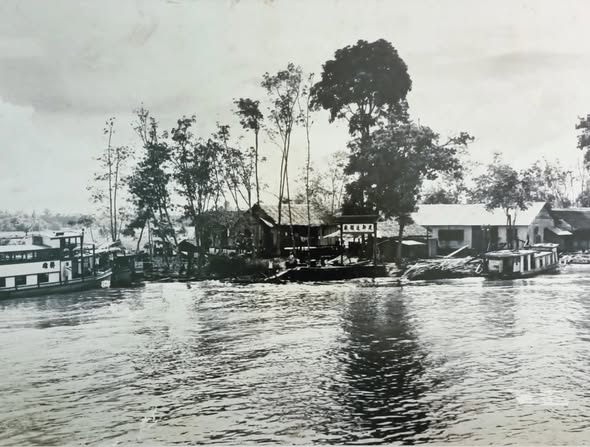
From coconut trees to steel: How Sibu built its shipbuilding industry
Only social or community posts, or a single source.
What happened
SIBU : Long before Sibu became known for steel tugboats, barges and offshore vessels sailing to markets beyond Sarawak, its shipbuilding story began with a few men working beneath coconut trees beside the Rajang River. (Sarawak Tribune, 16:12)
Read the reporting
1 reportFrom coconut trees to steel: How Sibu built its shipbuilding industry
SIBU : Long before Sibu became known for steel tugboats, barges and offshore vessels sailing to markets beyond Sarawak, its shipbuilding story began with a few men working beneath coconut trees beside the Rajang River.
There were no proper shipyards, sophisticated machinery or naval architects.
There were only basic tools, practical knowledge and a willingness to learn through trial and error.
The story of Sarawak’s maritime industry is documented in “Sarawak Maritime Industry: Sailing Ahead, Staying Resilient”, a book published by Sarawak Association of Maritime Industries (SAMIN) in collaboration with Universiti Teknologi MARA (UiTM) Sarawak Branch in 2024.
The research traces the formal beginnings of Sarawak’s shipbuilding and ship repair (SBSR) industry to the establishment of Brooke Dockyard in Kuching in 1912 by the White Rajah.
While Kuching was the birthplace of the industry, Sibu eventually emerged as its main centre, driven in large part by enterprising Foochow settlers who recognised the importance of the river to the town’s future.
The research places the beginning of Sibu’s shipbuilding industry in the 1930s, with 1935 identified as a significant starting point.
Local builders began constructing motor launches for river and coastal travel, as well as vessels supporting the timber industry.
The timing was significant.
It was also the 35th anniversary of the arrival of the Foochow settlers from China led by Wong Nai Siong in Sarawak.
For these early settlers, the Rajang was more than a river.
It was the highway connecting Sibu with the vast interior.
With roads and other infrastructure still limited, boats were essential for transporting people, agricultural produce and goods throughout the Rajang Basin.
Sibu’s location at the meeting point of the Igan and Rajang rivers made it both an ideal place to build boats and a place where boats were desperately needed.
The pioneers saw the opportunity.
From 1935 to 1940, they built small wooden paddle boats with pointed ends at Telok Selalo, about an hour’s boat ride from Sibu town.
There was no shipyard. There was no workshop.
The builders simply worked under coconut trees, tying their boats to the trunks.
Customers would tell them the size of boat they wanted or how many passengers it should carry. The builders then set about making it.
When the boat was completed, they watched how it performed on the river. They compared it with earlier boats, learnt from mistakes and tried again.
That process of trial and error became their classroom.
It was a remarkably humble beginning for an industry that would eventually develop into one of Malaysia’s major shipbuilding centres.
However, before the young industry could gain momentum, war came.
When Japanese warplanes appeared over Sarawak, the boatbuilders fled into the jungle, abandoning their work and boats.
Their fledgling industry was put on hold.
When the Second World War ended in 1945, they returned to their craft.
Far East Shipyard has its humble beginning in the 60s
Sarawak’s shipbuilding and ship repair (SBSR) industry begun with the establishment of Brooke Dockyard.
This time they moved closer to Sibu, to Sungai Sadit, where they began building larger vessels to carry goods.
The boats were fitted with outboard engines ranging from 50 to 100 horsepower.
They later built fishing boats known as “kotak” — Malay for “box” — for the seafaring Heng Hua community.
The growing demand gave the pioneers confidence.
In 1947, Kiong Sing Shipyard was established.
It marked a major step away from the days of building boats beneath coconut trees.
Far East Shipyard Co Sdn Bhd in Sibu has been in the ship building industry for as early as 1947.
Established in 1961, it is now recognised as one of the oldest ship building companies in Sarawak.
Other shipyards soon followed.
Kiong Tai was established at Tanjung Maling in 1954, followed by Ngie Lee Dockyard five years later.
Ngie Lee introduced another important development — a slipway.
Before that, boats had to be repaired according to the river’s tide. When the water receded, the builders had a window to work on the vessels.
The slipway changed that.
Boats could be hauled up for repairs without the shipbuilders having to depend on the falling tide.
The industry continued to evolve.
In 1961, shipbuilders met to discuss a possible merger. The talks did not result in a complete consolidation, although Sibu Shipyard and Kiong Sing Shipyard eventually merged and became Far East Shipyard Company Limited.
By the 1960s, around five shipyards were operating in Sibu, with many located around Sungai Antu, a tributary of the Igan River.
Sungai Antu became Sibu’s first industrial zone and attracted shipbuilders with the space and facilities provided by the colonial government.
Then came another challenge.
Steel.
For generations, the builders had worked with wood.
The idea of making a boat out of steel seemed almost unimaginable.
But when steel-hulled boats began appearing, the pioneers realised that their survival depended on adapting.
They experimented.
Once again, there were few drawings and little formal engineering knowledge to guide them.
They relied on experience, instinct and the lessons learnt from every vessel they built.
The results surprised them.
Steel-hulled boats could be faster and more efficient, opening up possibilities that had not existed with traditional wooden vessels.
By the early 1970s, the transition from wooden to steel vessels was largely complete.
It was a defining moment in Sibu’s shipbuilding history.
The new vessels transformed river travel.
Express boats became faster and lighter, cutting the journey from Sibu to Kuching from about 12 hours to around four hours.
The river, once associated with long and difficult journeys, became a faster transportation route.
The change also coincided with one of the biggest economic booms in Sarawak’s history.
The timber industry booms of the 1970s created enormous demand for vessels.
Speedboats and express boats were needed to transport timber company executives and workers to remote camps.
Tugboats and barges were required to move heavy logging equipment and timber.
For Sibu’s shipbuilders, it was a period of rapid growth.
The town prospered alongside the timber industry, and shipbuilding became an increasingly important part of its economic landscape.
But prosperity did not mean the industry could stand still.
When the timber industry declined in the mid-1980s, Sibu’s shipbuilders once again had to adapt.
This time, they looked beyond Sarawak.
The industry began producing vessels for customers outside the state’s timber sector and eventually entered international markets.
From the 1980s onwards, naval architects began playing a greater role, bringing formal designs and international standards into an industry that had once depended heavily on practical knowledge passed from one builder to another.
Some yards moved into ocean-going vessels, while others specialised in tugboats and high-speed express boats.
The transformation was remarkable.
An industry that had started with wooden boats built under coconut trees had become capable of producing vessels to international standards.
The 2024 UiTM publication also records an important milestone in the organisation of Sibu’s shipbuilding sector.
The Sibu Shipyards Association (SSA) was formed in 1974, when seven shipyards were operating in the town.
The association subsequently served as a link between industry players and government agencies, including those involved in industry development and investment.
Brooke Dockyard is one of the earliest shipbuilding shipyards in the state.
The timber boom in the 1970s inspired the rise in shipbuilding in Sibu.
The research places Sibu’s shipbuilding and ship-repair industry within the wider development of Sarawak’s maritime economy, while highlighting the town’s particular importance as the state’s main shipbuilding centre.
But the industry’s story is not only about growth.
The UiTM research also points to the challenges facing shipbuilders, including competition, the relatively limited local market, high costs of imported materials, substantial capital requirements and the need for more highly skilled workers.
The industry has to compete for contracts ranging from tugboats, trawlers, express boats and speedboats to larger and more technically demanding ocean-going vessels.
For Sibu’s smaller yards, competing for larger international contracts requires investment in technology and expertise.
That makes the question of manpower increasingly important.
The research highlights the need to develop young people in fields such as marine engineering, naval architecture and maritime technology so that the industry can continue to evolve.
It is a challenge that brings the story back to where it began.
The pioneers of Sibu’s shipbuilding industry had no formal courses in naval architecture.
They had no computer-aided design systems. They learnt by watching their boats move through the water.
They built, tested, compared and built again. Their workshop was the river. Their classroom was experience.
And their determination helped establish an industry that would survive war, technological change, the rise and decline of the timber boom and the demands of international markets.
From wooden paddle boats at Telok Selalo to steel tugboats, barges and offshore vessels, Sibu’s shipbuilding story is ultimately a story of people adapting to change.
The industry may now operate in modern shipyards and build vessels for customers far beyond Sarawak.
But its foundations remain beside the river, under the coconut trees, where a small group of pioneering boatbuilders first learnt how to turn wood into vessels capable of carrying Sibu’s future.
Some of these coconut trees still stand tall within the shipyards, serving as living reminders of the past.
They tell a story to us and future generations — a story of humble beginnings, perseverance and the journey that brought Sibu’s shipbuilding industry to where it is today.
Why it is new
- No engagement data available from these sources; score uses mention signals only
Attention graph
Timeline
- DetectedFirst detected (Sarawak Tribune) source
Where it started
How it spread
- Step 1News outletsSarawak Tribune16:12
Internet reaction
No social or community posts about this yet from the platforms we ingest.
What we know
- Covered by 1 established outlet(s): Sarawak Tribune
What we don’t know
- Independent confirmation is missing; treat specifics as unverified
- Only one source so far
All sources (1)
Attention is measured from these mentions only. Platforms shown: News. We never invent signals for platforms we do not ingest.
Follow for your feed
Follow the topic or the people and places in this story and they shape your For you page. Kept in this browser only.